International Walter Benjamin Conference 2019 “Benjamin’s Beginnings”
This reaserch explores Benjamin’s reflections on the Novel, and the evolution of his perspective through the years. The analysis begins from the concept of the Novel, as Benjamin defined it in The Art Criticism in German Romanticism, but considering the essays on language as a conceptual background. Then it compares that perspective to its new developments in one of the Benjamin’s literary turning point: Crisis of the Novel (1930). The romantic concept of the Novel as a form that can contain other forms—as a medium—becomes necessary for the realization of the literary montage. Therefore, in his essay Crisis of the Novel, instead of an actual debunking of the ’traditional’ structure of the Novel—exemplified by Gide’s The Counterfeiters—, it is possible to recognise an evolution of Benjamin’s perspective that still has in the romantic concept its essential precondition. The ’new form’ of a Novel that aims at reflecting reality’s autenticity should be the literary montage, as in Döblin’s Berlin Alexanderplatz, the very same form that Benjamin explicitly chose, in the same years, for his Arcade Project. Furthermore, in The Storyteller (1936) the Novel seems the only literary form in the modernity still able to connect—allegorically—the individual to its sense of life.
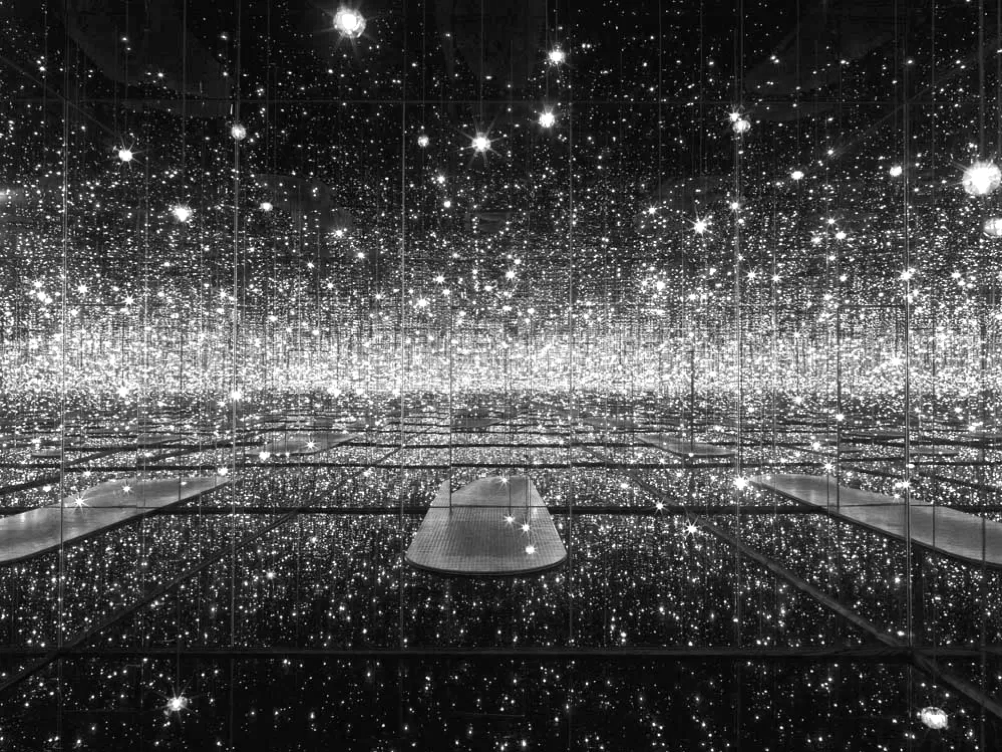
Image: Yayoi Kusama, Infinity Mirrored Room – The Souls of Millions of Light Years Away, 2013.
 Caterina Diotto