Co-authored with Mariateresa Muraca, Annamaria Piussi, Chiara Zamboni. Translated by Caterina Diotto.
The original version, in italian, was published here.
Antonietta Potente: Thank you for the great trust you have shown in my story. It is a part of me that I feel very strongly, that I can never shake off, that has truly shaped my way of seeing life. Even here in Europe. In Bolivia, the people I lived with, who are the family that took me in, said the last time I went there a few years ago: “You are one of us who lives in Europe. You are working there, and that’s fine. We are waiting for you and we will help you”, referring to their rituals, which are like a blessing before you leave. And it’s true, I feel that there is more of my blood there, I don’t know, sometimes I thought that maybe it’s reincarnation, maybe I was an Inca before, I don’t know, maybe a stone at the foot of the great mountains, even though I am terribly a sea person, so I have never denied that, even when I was at high altitudes. So, when I talk to you, I talk about my experience and what I have been able to understand.
Then, of course, when I was a lecturer at the University of Cochabamba, we worked a lot in this direction, from when we started to develop a so-called Indigenous Theology. Those were intense years. So it was normal with students in all subjects, at least those I taught, to always address this great relationship with indigenous life. Then, working in the field of ethics, I was always aware of this great and complex subject that is the universe. There too, the universities were more influenced by the West. But Brazil made a great contribution to theology, not only through Ivone Gebara but also through Leonardo Boff, who made a truly remarkable contribution. However, when I went to a liberation theology conference, for example, and the topic of the body came up, I already felt a disconnect between non-indigenous and indigenous theological reflection. I was asked to speak about the body. I said that I was not indigenous and that they should have invited someone else, but they wanted to give me that topic: the body in indigenous cultures. On the other hand, when I finished speaking, some people were really happy – Ivone [Gebara] was there too – and they said that I had brought a different perspective. I think Bolivian culture has this extra something. And I’m not saying this because I lived there, but because I’ve seen many other countries. Bolivia has this extra indigenous quality, as does Guatemala, for example. Even in terms of numbers, it is an indigenous country. I think this inevitably leaves its mark, naturally on those who want to be marked. There are those who live there and remain sure of what they know and therefore do not let others teach them anything that might lead them astray from what they know.
Chiara Zamboni: If you want, we can start with what you just said, that you felt a difference between the way of behaving, speaking and feeling the body in indigenous and non-indigenous reflection. So you could start – at least this is the first question – by saying what difference you felt between a body in indigenous reflection and a body in non-indigenous reflection. In a certain sense, it is important to start with the body because the body is the gateway to feeling the earth and the cosmos.
Antonietta Potente: First of all, it is always very difficult to talk about it because for them it is not an ideological issue. That is, there is no real reflection. Perhaps now there is, due to the process of transformation they are undergoing. It was the intellectuals, and especially the men, who tried to reflect on and systematise all their experiences. But my approach is different: I talk about my experience in daily life with this indigenous family, which is what allowed me to enter the indigenous world. There is no systematisation, no thinking about the body or the relationship with the earth. I felt that these people live in a pre-theoretical, original state, yes, original. I would say that they are chaste in their relationships, that is, they have no intermediaries, no ideologies. I am talking about very simple people, even those who have studied, because the youngest members of my community, where I used to live, two of them, a boy and a girl, had studied, but they too have this spontaneous relationship with life.
If you ask them, they probably smile, don’t say much, or tell you that they learned it from those before them. In other words, there is always someone who passes on this relationship with life. For example, those they call “los antepasados”, or their mother. The family that took me in consisted mainly of the mother and five children (four boys and two girls). The mother was quite old, and the children were also quite grown up. So, the relationship with life is something that is passed on. In order to live this relationship well and to know certain things, you have to be taught; you don’t learn it from books or theories. For example, someone has to teach you about plants, as well as how to use them for healing. You have to try to understand how to move, so someone has to teach you how to read coca leaves.
There is therefore a direct relationship between what is a body, a very complex body, and the “earth”.
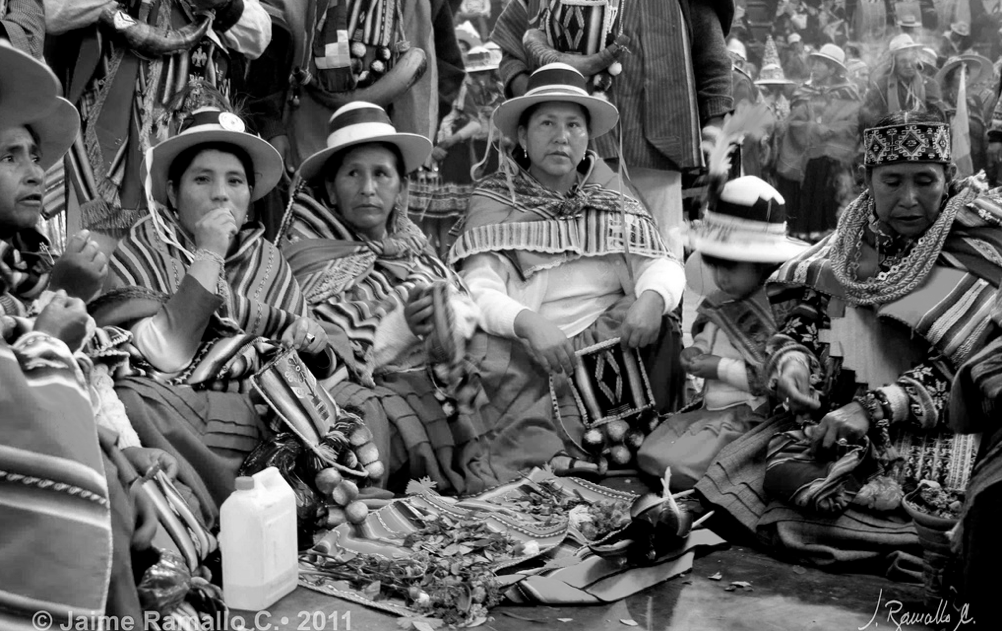
I imagine that if you read Latin American authors, you will come across the question of the so-called “Pachamama”. “Pachamama” was translated by the Spanish, who did not understand much about these peoples when they first encountered them, as “mother”, in reference to “mama”, while “pacha” was translated as “earth”. But “pacha” in the Andean mentality, or rather in Andean life, which is more than a mentality – I am talking about the Andean experience, because in Bolivia there are all the branches of the Guaraní, Guarayo, Toba and other peoples – in the Andean experience, “pacha” is not earth, it is much more: it is all this space, visible and also invisible. So there is the earth below and there is this intermediate earth, which is ours, which is made of earth, animals, plants and people. And there is the earth that we cannot see, which is the place of those who have already inhabited this earth, who are the antepasados and who remain ever present. Without the permission of the antepasados, nothing can be done, not even a meeting can take place without asking permission from the antepasados, the ancestors. So the relationship is a very complex one where there are many bodies, there is the body of these people, that is, the human body, which, unlike in Amazonian cultures or where it is warmer, is more covered because it is cold. You don’t see it much in summer… but otherwise you have to be well dressed all the time. Now, this body knows that it has a deep relationship with something else. It knows this not only because someone taught it to them, but because, if they are able to look, they understand it from life itself. They have a relationship with all these realities, which for them have a name and are subjects. The earth is a subject and the earth is fed, and at festivals it is the first to be served. It is served in a real way, like a person. The first course is prepared, you serve the first course from the pot and give it to the earth, you take it outside to the earth. Then the body is real. The question that arises is: what is behind this communication with the body? It is the same with the sun: if the sun is obscured, they think that something is no longer in harmony, and then everyone, men, women, children and animals gather together and at the moment of the eclipse, everyone beats their bodies, they flagellate themselves, but not too hard, even the animals, because everyone must cry, because something has happened and has hidden this harmony.
Now I can understand that, for a Western mindset, for example, of all those who were in Bolivia and who came from Europe or North America, such a thing might seem a little crazy, but in that context you realise that there is a really close connection with life. It is in this context that the question of need comes into play and makes sense, namely that there is a close link between my life as a human being and life in general, or rather this life that belongs to the earth, to plants, and to what you sow. So, for example, gestures that are normally made between people, such as kissing, are also made with the harvest. Perhaps this was also true for us in the past, I don’t know our farming societies, unfortunately I am a city dweller and, what’s more, I live by the sea. In other words, in this context, the body is not sublimated. The body is cared for, but it can only be cared for by the earth, by this environment. Everything must somehow remain connected, you cannot escape it. If you break this connection, then something happens to you too. So when you are sick and need treatment, you have to involve the earth. Normal medicines are not enough, but you have to involve the earth in some way, perhaps by making an offering. These rituals are sometimes performed on particular days of the week, other times when the community feels that special help is needed and that the balance needs to be restored. I received rituals on my body many times, and not only when I was towards the end of my time with them, when I was very ill and then left. I must say that they made a very accurate diagnosis of my illness. It is through rituals that they make their diagnosis and, coincidentally, the diagnosis always concerns harmony. That is, your having moved away from some relationship, so to speak. But other times I was really healed. And they don’t just heal with herbs, they heal with the earth, for example with minerals, with particular stones, especially brittle ones. Then with the whole ritual, which has precise gestures.
So I would say that the body is a body in relationship and cannot live without this relationship, both with the present and with the past. Although this is a very relative concept in the Andean world, the concept of time is quite unique because it is mainly the past and the present that are important moments, which must always be remembered. In other words, it is the past that has created the present; the future is in the present: there is no concept of the future in itself.
Now it seems to me that the most important aspect is this: the body is in relationship, and this is everyone’s need.
Now, this can also be seen in the way life unfolds in an indigenous community. When a child reaches the age of one, they are welcomed into the community and are already considered a member who can take on responsibilities, albeit limited ones. For example, a ritual is performed, during which the child is given an animal as a gift. They did this ritual for me too when I turned one year old in the community and gave me a lamb, which I had to raise – with some complications because I was going to university. I would come back, take this lamb, graze it where there was some grass, bring a book with me, and the lamb would eat. And so I raised it. When they gave it to me, I had to keep it with me for the first few nights, with all that that entails, because it was small. They do this with everyone, and I am telling you this because I think it is important to realise that being a member of a community means that everyone has something to do. That is when relationships multiply. It is normal for children to work in those communities. In Europe, we are scandalised that children work – I’m not talking about child labour. I repeat: all this is done in harmony. Bear in mind that today, in the suburbs of cities, you can find many different things, but in communities that are still closely tied to their knowledge, that is, to their deep appreciation of life, every member of the community, from the age of one, has their place. Just like every animal. For example, you cannot leave an animal without a name because they think it will not survive. Every chicken in our house had a name. And this name is interesting because it is always linked either to the animal’s external characteristics or to something about its behaviour that you remember. There are festivals where a kind of baptism of the animals takes place, of the flock for example, on 24 June, which is the longest and coldest night of the year because it is winter there.
This is the relationship with the body: they are bodies in relationship, which must take care of each other. Where everyone has a responsibility. And this responsibility sometimes becomes discernment about the behaviour of those who, for example, have become violent and dangerous to the community, such as those who commit violence against women. In these cases, they become very, very strict. If this person does not change their life and persists in raping someone, they are capable of killing them. Really. So much so that when there was an indigenous government in Bolivia, which lasted until 2019, it had to pass two types of legislation, one for the campesinas communities and one for the city, because they have a different perspective; a different ethical vision, I would say.
Let’s consider this vision: on the one hand, there is the duty to take care of others personally, and on the other hand, however, it is nature that takes care, it is the earth, it is the plants. But it’s strange because when you ask the earth, you also ask los antepassados, those who lived before. What emerges is the vision of a complete community, there is the present, there is the past, the earth takes care of you, the plants take care of you, some stones and those who lived before you. It is precisely on this point that I notice that this is not the case in the West. In the West, we even have the idea that we can save nature. There was talk – fortunately a little less now – of setting ourselves up as guardians of creation. But this is absurd, first of all because we are the ones who destroyed it, and secondly because we cannot continue in relationships where we always play the part, which seems to me to be a very patriarchal and male-dominated role, of those who somehow think they always have to take care of things. Instead, in their view, it is also the earth that takes care, it is also those who are no longer here. This is also true in many other cultures where the question of the dead is very important; in Bolivia, I find it interesting because the dead are always mentioned in relation to this gesture you make to the Pachamama. In this sense, the Pachamama encompasses everything: it does not only encompass that territory, that land you have.
If you want to get a little philosophical and add something theoretical, I remember that in the Aymara and Quechua world there is a kind of binary system based on the couple: the woman prepares the furrow, the man sows. Even the moon and the sun have roles. The sun is called Tata Inti, which means “sun father”; the moon is Killa and is the mother. So there is this sense of the couple, of going in pairs. So much so that – I tell you honestly – they only understood that I, for example, was not married and had no intention of getting married because I had spent my whole life with them. They were my couple, in the sense that they completed my life, according to their mentality. And this sense of the couple is also present in nature, in trees. So the tree that bears fruit is female and the one that does not is male. This is clear, and it is also true.
Let’s return to the body: the body is not just my body, it is the place of bodies. There are many bodies in relation to each other, there is no idea about the body in isolation. In fact, everyone thinks of themselves in relation to others, in relation to a partner, or in relation to a community, or in relation – very important – to a son or a daughter. For women, it is very important to have children. So it is the body above all that reveals this power of relationships. I don’t know if that’s clear.
Caterina Diotto: I have a question, I don’t have the right words to ask it, but I’ll try to explain: how is the earth conceived? Is there a sense of ownership or, to put it another way, is caring for the earth the responsibility of a specific generation or does it belong to everyone? Do people have ownership, in the sense that those trees are my trees, these animals are my animals and therefore I have to take care of them, and so there is an idea of ownership, or does it belong to the community?
Antonietta Potente: There is an idea of community or family ownership – I’m talking about the place where these people were born, whom I consider my second family. They were born at 4,000 metres, between Potosí and Oruro, where we used to go in the summer because they still had llamas, and they would say to you, for example, ‘This big mountain is ours”, or “it belongs to the Tacachiri, which is our surname. That other one belongs to someone else because it belonged to another community”. Now the communities are growing and shrinking, in the sense that a community would normally grow because people would marry and have children, and it would expand. But if, for example, a woman went to live in her husband’s community, she became part of that particular community and became the owner of that place. There is not so much of an idea of individual ownership, at least there wasn’t, but then those who move to the city unfortunately have to change their mentality. In addition, there are also different laws, but for them, property belongs to those communities. Bear in mind that the term “family” is not used by the indigenous people; it came in later, when the Church put it into our heads with the new law, but it didn’t exist before. So much so that in the new Constitution, when an indigenous government was elected. The article concerning the family was immediately removed and the word “family” disappeared and was replaced by “community”, because community is the great meaning of life for them, it is the great relationship. In this sense, this community can have property. Then who can tell me that that “cerro”, as they say there, that mountain, belongs to someone? A mountain is not closed, and they know that they can take their llamas and alpacas there to graze, but there are no signs of ownership or recognition.
Caterina: I was wondering who is responsible. You said that everyone has to do things, but I imagine that there is a gradation depending on age, as you said.
Antonietta Potente: Yes, indeed, everyone has to do something according to their abilities. You wouldn’t make a child the head of the community. But you would send him, or her if it’s a girl, as soon as he or she is able, to take the llamas, to look after the flock. In fact, it is almost always boys, girls and women who look after the flock. It is not customary for the head of the family to bring home the money, and this remains the case even when they move closer to the city. It is almost always the women who do this. They are the ones who sustain the economy. And I believe that this concept of community ownership does not stem from ideology, even though it has been cloaked in ideology by some, but rather from a need to survive. And from the fact that you are born in that territory. It is true that today they move around, but before it was not so much the case. That territory is home. Your first home is the place where you are. So when we talk about mother, it is not just the one who gives birth to you. The term “mother” itself carries the meaning of care: you feel cared for by Mother Earth because she feeds you. But Mother Earth does not do this alone, because you also need rain, you need the right amount of sun, you need winter, not just the seasons but the coldest and least cold periods. There is a life cycle – we would say – that is very connected. And even when they go to the city, even when they live in the suburbs, for example the women we worked with on the outskirts of Cochabamba, they continue to live like this. It is a feeling that persists. It seems to me that it is something they have inside them. Now, I don’t know about the children, who then start living in the city, whether they continue to feel this way, but those who have lived with this wisdom for a long time do not forget it so easily. Even when they study, for example, one of the young men in my community studied biology and could study everything they taught him at university, all the various theories, but when he had to choose, he chose the advice of someone from the community. Everyone said, “Look, you’ve studied…”. No, no, no. So much so that he is now a naturalist doctor treating people only with Bolivian plants. So, in my opinion, it’s a visceral connection with the land and all its fruits, and if they call it “mother”, it’s a visceral connection.
Chiara Zamboni: When you said that women work, I also read Mariateresa’s book on the Women Farmer’s Movement (MMC) in southern Brazil, and I feel the strength of women. It’s not that men aren’t there, they do exist, but you feel that women have greater importance in that context. So how could you explain this? I don’t think it’s matrilineality, but there is definitely a greater strength in women, perhaps because they are the ones who work harder… if you wanted to say something more about this.
Antonietta Potente: They seemed the most creative to me. And then it’s true, there are very few men. They’re not very present; only a few. For example, even in meetings, if you go to Andean community meetings, it seems that it’s the men who decide and speak, but at their feet are the women, and if you notice, it’s the women who make suggestions. Now, the management of the economy, even in the city, in the suburbs, if they are indigenous women, is in their hands. It seems to me that patriarchy in those places was brought about by colonisation and evangelisation. I don’t know if we can talk about a matrilineal genealogy, perhaps not. However, being there always gave me the impression that patriarchy is a matter of colonisation and evangelisation, that is, it has been very strongly marked and, moreover, in their way of feeling life and even beyond life, they have been very, very marked by Christianity, even if they don’t go to mass, even if they don’t care about it, even if, fortunately, they have transformed the Christian holidays. For example, Good Friday is the day when people eat the most, twelve dishes, because it is to console the apostles. And then every year the Church would put up notices inviting people to eat on Maundy Thursday. But we did it on Friday. Or Corpus Christi, in June. It’s a holiday they call the feast of the body, and it’s the day when you eat sweets and fruit in the morning at a certain time, you don’t go to work, because down there it’s still a public holiday, even at the state level, so we all get together at home, and at a certain time in the morning we eat sweets and fruit, lots of fruit. When I asked why, they said, “Because it’s the day for taking care of the body”. Corpus Christi had become this, and I was very happy. These are their reinterpretations of the holidays, but Christianity has had a very strong influence, so women today still have to free themselves from this patriarchy, and they are doing so. In some cases, they do it much more than we do, but in other cases it is more difficult. This is why they come together to free themselves, to be stronger. They learn to read together, they learn to do jobs to increase their income in the domestic economy, to be stronger, to have a much larger space.
Chiara Zamboni: When we were preparing to plan our work together for the interview, we were saying that there is a form of implicit feminism in Latin American countries. I don’t know if you can actually call it feminism, but from what you say, it is clear that there is a process of forming, reading and working together to liberate ourselves and become stronger as women. Feminism has this aspect of women’s strength coming from their relationships with each other. It’s probably wrong to use the word feminism, but there’s definitely an awareness of a female strength that comes from women’s bonds with each other.
Antonietta Potente: They exchange a lot of energy and help each other. For example, there are women who have violent husbands and they meet with other women to do something, to learn something about health, how to care for their children, nutrition, and they are helped by other women.
Anna Maria Piussi: What you are saying reminds me of my experience in Brazil. Bear in mind that we were in north-eastern Brazil, in Piauí, which is actually the poorest area of Brazil. There we met several groups of women, some of whom were producers, in the sense that they had small cooperatives. Then, of course, we also met university lecturers, one in particular I remember from the University of Maranhão, who was an incredibly strong woman. There, in that area of Brazil, many women are heads of households, even if they have husbands who have emigrated to the south of Brazil, which is richer, to find work and opportunities. So the great contradiction that I, but also the other women I was working with on this project, other Italian women, experienced and that I never got over was that this strength, which was a truly visible strength of these women, those who had families and were heads of households, and then there were also single women, and then, above all, these community ties between women to give themselves authority, to give themselves strength were very visible, but the ideology of equality, which was experienced above all in academia and universities, including our colleagues, our project partners, even Afro-descendants, had this idea of equality in mind and did not see strength, not even their own, not only that of other women but not even their own. Then the project resulted in various actions in the Teresina area, etc., and also in papers that gave rise to a master’s degree, the papers of the master’s students, apart from the fact that they all cited Western authors, as Mariateresa knows because I have told her several times. They hardly even mentioned Freire. But with this vision, how can I put it, completely colonised. I was interested in different things.
Antonietta Potente: I’m talking about women from the suburbs who don’t have jobs, who work at home and who got together to express their artistic talent: theatre. I think it’s really, really beautiful. One thing I’d like to point out is that, unlike other peoples, they are not animists. But it’s strange because, even though they are not animists, every creature is a subject, a subject with its own characteristics. I’ve always liked this because, even though I don’t come from the countryside, I’ve always had cats and dogs, and I’ve always thought that they had a soul, that they were like people, when I was little, and that the sea was something to be respected. That’s where I found this thing, I found this great respect, especially for the earth, for not doing harm. Even animals, precisely this fact of giving them names because otherwise they don’t live; many have said that it is animism and pantheism, but it is not. When you perform a ritual, for example on Carnival day, you perform a ritual dedicated to the home, especially to the earth and the home. For example, in my community, the oldest mother would bring incense and copal, and in front of the dishes in the kitchen she would say a prayer that there would always be food to eat, or in my room where there were many books, that Anto would be healthy, study well and learn many things. This is not animism, but care for life; everything is important, everything must be cherished.
And I think there is also another issue here: living and working the land in the Andes is hard, as Chiara perhaps remembered. I said it was hard, it’s not romantic, and when it’s cold, it’s cold, there’s nothing to keep you warm. They don’t use fire because there’s not much wood; in fact, if you go higher up, at 4,000 metres, there’s none at all. There is nothing romantic about it, harmony is not easy. It is not a fertile land. If you go to the tropics, it is different: you throw a seed and the next day something sprouts. Not there. There, you have to get in touch with the environment, you really have to take care of it. So they know that life there is hard. When I asked to go and live with them, because I had met these two younger people, the boy and the girl, while I was also asking permission from my congregation, they asked permission from the community to take me to live there. The mother, the eldest, said, “Tell her she’ll suffer. Think carefully because she’ll suffer here too”.
Chiara Zamboni: But why did you want to live with them?
Antonietta: Because living as an Italian in a totally different country with a strong culture, and living among us nuns even though we were very well integrated in a large suburb, was not enough for me. I really missed another soul, seeing life from another perspective. And my efforts, our efforts, were not enough. I really wanted to live in a minority. Because I noticed that even when my two companions from the community came to visit me when I was already living with this indigenous community, as soon as we got together we became a separate group. But to live in these countries you have to be in a minority, otherwise… I taught at the university, so I was able to approach it only from an intellectual point of view, which was interesting but not enough. I also had indigenous colleagues, especially in the field of anthropology. But it was different, partly because those who had studied had done so with Western tools.
I really needed (to live in a minority), otherwise I would have gone back to Italy. Apart from the fact that I had said that if my sisters (nuns) didn’t let me do it, I would have done it anyway, I didn’t care. But these are my whims, either I did that or I went back to Italy. Because it’s really different. It’s true that you can hear anecdotes told by missionaries, who will always tell you about the misfortunes of these peoples, but living in a minority and being hosted is different. For example, they (the Andean people) tell you that misfortunes are not to be talked about, that it’s their business, that we have to fight together without making a fuss. So your perspective changes. I always consider it a reversal, like being in the womb, and you are reborn into another world.
Mariateresa Muraca: I wanted to ask a question, picking up on something you mentioned earlier about dualism. With regard to the idea that patriarchy was brought about by colonialism and evangelisation and that it is therefore necessary to pursue paths of liberation, do you think that this symbolic framework of dualism supports this type of liberation process, or do you think that it may be a limitation? I ask because I have often encountered this in international meetings, in meetings held in Brazil but attended by women from different parts of Latin America. I felt that this was a major source of conflict, in the sense that many non-indigenous women saw this dualism as a symbolic framework that could actually hinder the liberation of women. What do you think?
Antonietta Potente: Based on my experience and what I have been taught, rather than dualism, I interpret it differently, and that is how it has always been described to me. I remember, because I was lucky enough to teach at this university, in this Andean Methodist theological faculty, where everyone was Aymara or Quechua, and in a seminar they had called “on gender difference”, this question came up. That is, women plough the fields, men sow the seeds, certain jobs are done by women, certain jobs are done by men, this worldview of the sun and the moon. But it did not come across as two, but as reciprocity. This idea of reciprocity was very strong. Now, I know that for many of us, even reciprocity can become dangerous. But for them it is not a question of night and day, moon and sun, but a cycle of reciprocity, i.e. the sun is needed as the moon is needed, the day is needed, the night is needed, the rain is needed. A child, a boy or a girl, is important in the community because he or she does certain things; a woman is important, a man is important. That is, beneath this there are disharmonies, as there are among all human beings, but I would speak more about this strong sense of reciprocity. It is so strong that you cannot see it on your own. A woman remains alone (except in the city, where it happens more frequently) with great difficulty and sees it as a great tragedy within herself. Yet the funny thing is that almost all of them remain alone, at least in the city, because in the city men are very unfaithful. All the women in my community – except one, who is holding out – are alone, even the youngest. Maybe they got together with someone, got married, but after a year he cheated on them. However, this aspect of reciprocity remains in the mentality.
Even humans, speaking in our terms, are reciprocal to the Earth, to what the Earth gives, to what the Earth suggests to you, because everyone teaches something. I learned there that everyone teaches something, they refer you to something different. One day, when I was in the other community, the religious community I used to go to from time to time, there had been some differences between us in our way of looking at life, and as I was leaving, I saw a child with a little lamb. And that child with his little lamb taught me something: to be simple, for example, and to be gentle. I know that this reciprocity creates conflict today, between women and between feminists. But it exists. I may agree or disagree with it, but in the culture I have known, it exists.
Chiara Zamboni: One thing that emerged among us when we last met to plan this interview, something that characterises Latin American ecofeminism in a certain sense, is the involvement of a sense of justice. While within the US-EU environmental movements, the Western ones, let’s say, it is important but not so structurally present, so deep. The link between ecology and justice in European culture is more intellectual, whereas in this different context it is something that is felt. Not only because liberation theology has been present. I don’t think it can be reduced to that. From what we have said so far, a concept of justice as we understand it in Europe is not emerging. It seems to me that a concept of justice is emerging that is embodied in reciprocity and in the constitutive relationship, rather than a concept of justice whereby there must be a just distribution of goods among all, in an a priori and abstract way. It seems to me to be more linked to practices, and this is what I would like to ask you about. Because in Europe we always approach the question of justice from our own perspective: the distribution of goods, so that there is not too much difference between situations. Of course, Simone Weil criticises this concept of justice and proposes another, but here I am referring to the more widespread concept of justice. Whereas, from what you have said, a different concept of justice emerges, one that is more rooted in things.
Antonietta Potente: First of all, I would like to say that Brazil is already a world apart from the Andean world. In my experience, justice there is really linked to needs. It is not theoretical, ideologies do not matter, but it is right when something is given to you because you need it. And the need is satisfied with “just enough”. Today it’s there, tomorrow it’s gone. Today I might have a lot of money and I’ll party, call my friends and relatives and spend it all. We Westerners would look down on this attitude, thinking, ‘Oh my God, they’re crazy, what about tomorrow? Tomorrow they won’t have it anymore, they’ll sell something if they need to. In my opinion, this is a bit like the soul of justice, it’s pure practicality. It’s true that the soul isn’t practical, yet that’s exactly what it is: I don’t argue about my justice. I argue that I need these things. Let me go back to the example I gave before: we don’t have water, two months go by, three months go by, they ask us for money and we don’t have it. We have to do something and get together. When we got water, that was a journey of justice. But even then, it’s not that things went on, but no one theorised it. “Enough” and “how much is enough” are linked to the present. Not in theory, no, if you ask a sociologist, probably not, even if they are indigenous and especially if they are a man. But in life, I am telling you what I have experienced first-hand, which was this: just enough. It is sufficient, which can sometimes be abundance, but it is not for keeping. The logic of accumulation does not work there, and for this reason, perhaps, we should ask ourselves what political proposals we are making at a global level, because there we are faced with a mentality where accumulation does not exist. It is even more certain than the question of private property; they do not have the mindset to accumulate, and you can say that they will grow old, that there is no pension, or that there is but it is useless, all these things. Having just enough has greater energy. It is fascinating from one perspective, harsh and destabilising from another. In fact, we ask ourselves, it is not just the exploitation of multinationals, etc., but why does nothing ever happen in these countries? Or, unfortunately, the Caudillo, the dictator, comes to power because he promises me this, this and that, today.
Chiara Zamboni: It probably also has to do with the fact that the future is not the important dimension of time. Hoarding has to do with images of when we will be old, etc., whereas this way of living is very much tied to the present.
Antonietta Potente: To the present and to what they call “fatalism”, which is not fatalism but a kind of abandonment. I hear these days that there is an aunt who needs oxygen and there is no more oxygen, and they are doing everything they can to find it. Apart from the fact that it is expensive and therefore almost impossible to buy. And then they tell you that if they don’t find it, that’s the way it is, or God will take care of it.
Mariateresa Muraca: There is also the big issue of the rights of the Earth, which comes into play in the Bolivian Constitution, which was recently changed. There too, at least from what you say, I realise that rights are not private property, based on a concept of the independent subject, but on relationships.
Antonietta Potente: Yes, I think that “theories of rights” are really ours, or American, or Anglo-Saxon. There is this question of “what does the Earth need?”. But I would like to emphasise this: it is not that indigenous people have a great ecological awareness when they go to the cities. Perhaps you who have been to Brazil have seen this. For example, plastic is everywhere. The first time I went up to 4,000 metres, there were radio batteries thrown everywhere. And I said, “No, let’s pick up the batteries, because…”. This world has also made them ignorant. It’s not their fault, they don’t know whether batteries are good or bad. They are used to giving only natural things to the earth. In the suburbs of Santa Cruz de la Sierra, where I lived for four years, there is a lot of wind and the suburbs were built on sand, where there used to be a river. It was impressive because there were plastic bags of all colours flying everywhere and you didn’t know if they were flowers or not. So this is a big problem in my opinion. The force of globalisation has accelerated everything and no one has given people the tools to understand what was happening. And their wisdom fails them on this point. They don’t think about it, or rather, the younger ones are starting to think about it because they study, but the older ones don’t. The batteries are there, who cares? Then there aren’t even the means, it’s not like there’s separate waste collection there. In the community, we managed to do something, we burned the paper or took it to a centre where they made toilet paper. And when there is an exchange (of goods), you do it, but then there are no means. Where we used to live and where they still live, no one comes to collect the rubbish, so you either make do or take it to the city, but the city is one of the most polluted in Latin America. It’s almost on a par with Mexico City. Mexico City is bigger, and in fact it’s the most polluted city in the world. The trucks and other vehicles are old, the cars have been reused twenty times, so you can imagine the exhaust pipes. The issue is therefore very complex. With the indigenous government, the issue of land rights was included in the new Constitution, but then in practice it was very difficult. And I think this is what all peoples suffer from. I’ve seen it in Africa too.
Annamaria Piussi: While you were speaking, I was thinking that it is not possible to make broad generalisations, even about Latin America, because the situations are actually very diverse. And not only are there differences between cities and the countryside, forests, etc., but also differences in cultural histories. You rightly mentioned evangelisation and colonisation. Thinking of a country like Argentina, which I know very little about but have been looking into recently, and again without making generalisations because I’m more familiar with the situation in Patagonia, there is a strong feminist awareness that is not modelled on Western feminism. Ni Una Menos was born there, and the battles over abortion have only recently been won after decades. In any case, the mobilisation of women who do not live in rural areas – such as the Mapuche – but in relatively small towns in Patagonia, many of whom are feminist activists, strongly support the struggles of the Mapuche, for example. Compared to what you have said, the issue of land there is very different. Unfortunately, there is also a question of rights because the issue of rights arose following the expropriations that took place from the mid-19th century, perhaps even earlier, to the present day. As with the Benettons, who continue to obtain the expropriation of Mapuche territories because they are supported by various Argentine governments. There, the issue of rights has inevitably come to the fore, but from what I understand, there is not only a great sense of community, but also a defence of the land as a place and home for the community – not as property. Of course, it is the land that gives us our livelihood – and in this it could be similar to what you said about the reciprocity of the land with those who inhabit it – but then they got caught up in this funnel of the rights issue.
Antonietta Potente: The Mapuche are a minority in Argentina and Chile, although here they are much more organised. In Bolivia, indigenous people are the numerical majority. In my opinion, then, it is different because they have to fight much harder, because they need to.
Annamaria Piussi: Yes, but the interesting thing is that women of European descent live and practise a feminism that is not ours, even though they are not only of European descent but also educated in a certain way. They are very attentive to their relationship with nature, regardless of the Mapuche, and to that simplicity of life you referred to. They are not women who aim to accumulate, absolutely not, but they care about relationships, both within and outside the family.
Antonietta Potente: I think there is a very close relationship between “just enough” and simplicity – not ideological but real – and the whole ecological issue. I think that’s the big problem today throughout the universe, in all countries. It’s the fact that we are driven by this system of mass production, which if it doesn’t produce, it dies, and you have to buy, with all that that means, and there, instead, there is another economy.
Annamaria Piussi: Yes, it’s self-production that points in a different direction, the way of looking at things, the way of being.
Antonietta Potente: The problem is also seeing how long they can hold out. Because sometimes, in certain situations such as the pandemic, “enough” means poverty. It borders on misery or becomes poverty. And nature also suffers, because I imagine that all these health campaigns about “wash your hands”, “buy hand sanitiser”, and so on, mean plastic waste everywhere, masks flying around. So I don’t know, for me that’s also suffering, it’s not just the hard work of the land. When you come face to face with everyday life, it’s not easy to respect it. And perhaps that’s why there is a cyclical nature to the rituals in that culture, as if to ask Pacha Mama for forgiveness. It’s not so much God you’re disturbing, but the earth, and that’s true. This seems to me to be the great hardship that we, in the environmental movements, should also remember. It’s nice to read those things about the North American Indians, which are beautiful, but then you go and see them and most of them spend their lives sitting around drinking on the outskirts of big cities because there has been no recognition and no construction of rights for them. So their bodies suffer, their souls suffer and nature suffers, which is left in the hands of everyone.
Annamaria Piussi: I’ve always been struck by the difference between poverty and destitution. Outside the big cities there is poverty, perhaps the kind you were referring to, but when these people arrive in the cities, especially the big cities, this poverty really becomes destitution. And there’s nothing you can do about it.
Chiara Zamboni: It seems to me that this concept of “just enough” is not poverty, let alone misery, because poverty is something else. It seems to me that this element of “just enough” is what we need here too. If we think that “just enough” is poverty at the level of representation, then we can’t do anything about it. Another thing that strikes me is that it is not so much a question of rights but the fact that we lack the words to express this culture in a shared way. If there were a possibility of sharing this type of culture and therefore of expressing it well with words, it would be different. The question of “how much is enough” is something that concerns us. It is no coincidence that we are holding this year’s (2021) Great Seminar on needs. It’s a difficult topic, linked to many aspects and in particular to awareness of limits. But above all, we are committed to finding the words to express what needs are in a different way from the current one. This is also where its strength lies: finding words to describe the situation we are living in. Otherwise, we are symbolically erased from this type of experience by other prevailing paths.
Antonietta, both you and Mariateresa often talk about “buen vivir”. What is it? It seems like the right time to ask.
Antonietta Potente: Buen vivir is full enjoyment. Our home, the community there, was called Sumaj Causay Wasi, which translates poorly but would be “our language, the home of good living”. And this was the dream we had, and still have now when we manage to talk together via Zoom: the full enjoyment of being together. There – I don’t know what Mariateresa will say – it is really linked to being together. There is no buen vivir alone. It exists because the whole community comes together, shares, eats, drinks and celebrates. Buen vivir is very strong in this sense: it is taste, or pleasure, as Milagros (Marìa-Milagros Rivera Garretas) would say. Feeling pleasure, feeling a taste shared with others.
Mariateresa Muraca: Yes, I also feel it a little through the affection I have for the world of education, as a perspective in motion in which everyone has a chance to fulfil themselves in relation to others. I see it as a complete realisation, a path towards fulfilment where it is not only humans who are involved. One thing that struck me, I must say, is that when I was in Brazil – I went back in 2015 – buen vivir was perceived as something very much linked to the indigenous and Andean reality. Now, however, I see that the discussion is becoming richer, in the sense that other similarities are being found, there is a search for indigenous words from the various realities and geographical contexts of Latin America. A search for the words that the various communities and peoples use to express this fullness of life. But also a listening and learning about this indigenous heritage, this genealogy of thought. So it is also very interesting from a decolonial perspective because I see political communities of men, but also of women – there is in fact a female and feminist exploration of buen vivir – listening to the “indigenous universes”. I find this ongoing exploration very interesting. Then I see that sometimes it is also used as a way to homogenise thought or to create a category that ends up losing its fertility.
Chiara Zamboni: Excuse me, but where does this word come from?
Antonietta Potente: Sumaj Causay was the main theme in Bolivia’s process of change and in the Constitution. Ecuador and Peru then followed suit, and non-Andean indigenous communities also took it up.
Chiara Zamboni: So, let’s say that the Bolivian Constitution relaunched a widespread concept of what symbolically belonged to everyone, which was proposed as a guideline.
Antonietta Potente: It already existed and still exists in their culture. So much so that we said that the President had stolen the idea from us. I went there in January 1998 and we immediately started saying that our community would be called that. And it’s a very strong concept because if you look at certain texts, they translate Sumaj Causay as “peace”. But it’s not just peace, it’s much more than that. I think what Mariateresa says is very important. And then there is a buen vivir among women, women who come together and rediscover buen vivir, but I’ll leave that for this year’s Grand Seminar (2021).
Caterina Diotto: I would like to ask a question to everyone. This concept of buen vivir is somewhat similar to a concept that belongs to Italian culture, that of la dolce vita. This was then transformed into cinema with a whole aesthetic aspect in the 1950s, but it is also an earlier concept that has a lot to do with food, sensory pleasure and the joy of being together.
Chiara Zamboni: No, if you’ve seen Fellini’s film, there’s an element of decadence in “la dolce vita”, there’s a slight sense of death. It’s a beautiful theme, but with a twilight tone. In Fellini’s film, the Rome of la dolce vita has a dominant tone of letting oneself go to sensations, losing touch with life. Sensations were important, but they were an end in themselves, not an aspect of and openness to the world.
Annamaria Piussi: It’s a form of disengagement. Buen vivir, or “the good life” in the sense of honest, upright, or in an economic sense, has been misunderstood and continues to be misunderstood here in the West, which I believe is a distortion of the meaning of buen vivir as Antonietta and Mariateresa have told us.
Antonietta Potente: Yes, I believe there is always a male influence. We women know that goodness is a combination of factors and not just one thing. Therefore, I believe that women owe it to ourselves to work harder on this issue, which is also the issue of needs. Because men fragment this buen vivir, this pleasure. So we don’t betray its origins (by working on it in a feminine and feminist way) because buen vivir is not about demanding justice or equality, but about “everyone having enough”. Enough is what you need, it is your pleasure. However, I think that we women need to work harder on this, because when it is put in the hands of men – as happened in Bolivia – it then becomes ideological or fragmented, buen vivir becomes about the well-being of the individual and nothing else.
Originally published as:
Caterina Diotto, Mariateresa Muraca, Anna Maria Piussi, Chiara Zamboni, Intervista ad Antonietta Potente, Per Amore del Mondo n.18 – 2021/2022 Il mondo stringe ISSN 2384-8944.
 Caterina Diotto