co-authored with Vittoria Ferri, Annamaria Piussi, Giulia Testi, Chiara Zamboni. Translated by Caterina Diotto.
The original version, in italian, was published here.
Chiara Zamboni: (introduction) It is not an objective narration that we are asking Mariateresa, it is a knowledge that she has of her experience and of the relationships that she has with people in the state of Santa Caterina in Brazil. Perhaps since you are currently doing this experience in northern Brazil, we can extend the discourse to that area as well, beyond the texts. The idea, however, is not to objectively reconstruct the experience of the women of Brazil, according to a sociological approach, but to let those who have experience of those realities speak, taking into account the different intensities of experience. Much more can be learnt from the narration of an experience than from a sociological, economicist or theological reconstruction. An interview with a woman who brings formalisable and also non-formalisable knowledge is much more interesting than an objectified experience. This is also how we set up the interview with Antonietta Potente that we did last year and published in Per Amore del mondo. And at the end of the interview we also added what we gained from it, what shifted us from our preconceptions, prejudices or pre-knowledge we had, and we set this as our aim for this time too.
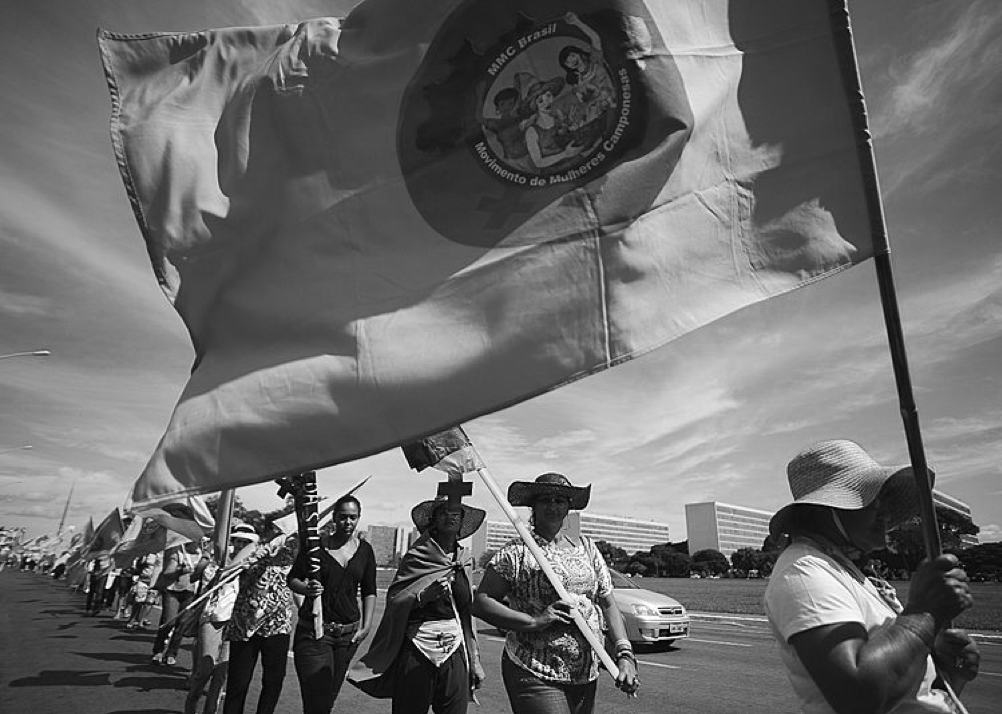
Caterina Diotto: One of the things that came to me spontaneously when reading Educazione e movimenti sociali. Un’etnografia collaborativa con il Movimento di Donne Contadine a Santa Catarina (Brasile) was the comparison with Antonietta’s account of the Aymara community. My feeling with respect to the Women Farmers Movement (in Portuguese, Movimento de Mulheres Camponesas – MMC) is that their approach to the conception of nature is not so different from ours as a basic schema, whereas that of the Aymara is.
That is, taking as a reference the four schemes elaborated by French environmental anthropologist Philippe Descola in Beyond Nature and Culture, the relationship between humans and nature in Western culture is called “Naturalism”. Between us and the natural world (animal, vegetable, mineral) there is a diversity of “souls”, i.e. we have different souls, but we are all made of the same material. Preponderance is given to the soul, i.e. the soul is the important thing, and this founds the European anthropocentric model. From what you described in the book, it seems to me that the basic conception for them is also Naturalism, because in the relationship with plants, seeds, animals, the garden, I did not seem to perceive an inherent transcendence. There is a transcendence in the relationship between people and these entities, but these things “in themselves” remain “objective”. I wanted to ask you if you agree with this interpretation, if it corresponds to your experience or not.
Mariateresa Muraca: The context in which I lived is very different from the one in which Antonietta lived. It was not an indigenous community, for example, but tended to be Euro-descendant, even though it was a context where people from different backgrounds met. It is a context that has a violent history at its base, because when the immigrant families from Europe arrived, the ancestors and forefathers of the women I met, they arrived in a setting characterised by the expulsion of those who already inhabited those lands, of the imposition of another model of coexistence, of working the land and of the relationship with the land. The women who inherited this set of relations did not question them at all. So much so that I attempted to open up this theme in the course of the research, to pose it as an issue. It seemed to me an important aspect given that the Movement, in the meantime, has become national; therefore, it brings together women from various parts of Brazil, with different histories and also within asymmetrical relationships.
I too perceived in Antonietta’s words a difference from our way of seeing nature, which I did not observe with the women of the Movement. Their relationship with nature is first and foremost mediated by the fact that they are farmers: they work with the land, they make a living from the land, not only for subsistence but also to generate income. What I think is relevant about this experience is that they have been and are constantly able, from their practices, to question the model they are in, the dominant vision of exploitation of the land for profit at any cost. They are working in another direction, and a very interesting one. They are developing a vision that is certainly counter-cultural, alternative and critical. In spite of the contradictions due to the fact that they came in as dominators. So many narratives clash there. For example, in the book I mention the narrative of pioneerism, according to which Europeans came to bring civilisation and progress even in agriculture. The women of the Movement inherited this narrative and did not question it to the full. But they were able to question one dimension of it: the “developmentalist” conception, which sees nature exclusively as a source of profit. This I felt, saw and observed, thanks to the privileged situation of familiarity, closeness and trust that they felt towards me and I towards them, and which I still feel today. And from here I tried to open up questions. I think that is also the beauty of research: to open up new questions.
Annamaria Piussi: I agree about the difference with respect to our relationship with nature and also with respect to the visions of nature of the indigenous Aymara community that emerge from Antonietta’s narratives about the context in which she lived in Bolivia, participating in it from the inside. Reading your book and your article on mysticism, I also noticed in these women not an objectifying attitude towards nature, on the contrary, one feels a flow of affectivity, an involvement that is also affective, not just operational, of work, much less instrumental aimed at profit. There is a loving gaze, which becomes very visible in mysticism, because not only the seeds, the products, but also the tools, their everyday world are made visible and invested with a sacredness. However, very distant from our worlds. In contrast to Antonietta’s context, I see a difference, but not so radical.
Mariateresa Muraca: when I listened to Antonietta, I felt that context was incomparable to what I had experienced and known. It is difficult to make comparisons, because one risks reducing what one is trying to approach to a set of traits. However, the affective investment is very present. I had never thought, for example, about the fact that our whole life depends on seeds; it is a simple thing but I had never thought about it before I met the Movement. There is a very strong link between life and seeds, they are what constitutes us; what we eat has a great influence on our mood, on our health, so there is also an affective investment in the knowledge that we are made up of what we produce and eat. There is no opposition, nor is there an instrumental view.
Then there is the theme of genealogy, very present for the women of the Movement: if they have partly inherited the discourse of pioneering, they have also proposed a completely different reading of it, recognising the importance of the ancestors and women who paved the way in their struggles. From them they recovered the practice of self-producing seeds, which the Green Revolution had branded as traditional, inefficient, because you have to produce to earn. But they have redefined it in a political direction, with a view to food autonomy and sovereignty: if we are made of seeds, we cannot accept that two multinationals have a monopoly on seeds worldwide and that we are totally dependent on them.
Giulia Testi: In your book you highlight the garden as central to the women of the movement. Less is said, however, about how the relationship with animals is conceived and meant. I would like to ask you a question on this subject. What you say about animals is mainly related to the Green Revolution, i.e. to the fact that a reduction in biodiversity was also applied in animal husbandry, as was the case in agriculture with regard to seeds. Thus, the introduction of hybrid breeds has been facilitated to the detriment of local breeds, for pigs; furthermore, the predominance of dairy cow breeding has been imposed. In short, I had the impression that the issue of animals was mostly approached as products and I found this somewhat problematic. Nevertheless, a different approach to the animal world emerges when you say that Lucimar, as a woman, on seeing the man spreading organic insecticide in the garden, thinks of the mouse that will pass by and be affected by the poison. So could you tell us more about how the relationship with animals is understood and acted upon?
Mariateresa Muraca: On the relationship with animals, I was told different visions by the women and families I lived with. However, there is a common problematic point, which is precisely the imposition of dairy cow farming following the Green Revolution. Milking, a practice mainly done by women, in fact requires their constant presence and is therefore experienced as a limitation, of life time and also with respect to participation in the Movement. Some have decided to overcome this type of constraint, through family reorganisation. Perhaps they prefer to keep only one cow and produce milk exclusively for family consumption: this certainly contributes to a different relationship with the animal. If then, thanks to this one cow, cheese is produced for sale, that animal also becomes the symbol of the possibility for the woman to have an income specifically of her own (not of the whole family). However, there is no shared vision within the movement on the relationship with the animal world but personal dispositions and experiences. In Zenaide, for example, I always saw an attitude of friendship towards her pets.
Chiara Zamboni: To begin with, I refer to the work of Lucia Bertell, who was engaged in giving expression to the farming practices of women belonging to a number of associations in the province of Verona. They too were very careful to preserve local seeds, which regenerate, against industrially produced seeds, which increase productivity, but at the expense of seed regeneration. Now, what I have observed in the stories of these women engaged in agriculture for a new way of life is that they lack a real political movement to support them. It is lacking both in Verona and in Italy in general, despite Legambiente’s attempts to give a political sign to these experiences. I realise this by comparing all this with what you describe of the Women Farmers Movement in Brazil, supported by a very strong political self-awareness, which passes through criticism of the capitalist exploitation of the land, which then implies a holistic way of life and so on. What could you add to this?
I have another question. I refer to the article you published in Per Amore del Mondo about “mysticism”. I realise that precisely in the practice of mysticism, which you describe, there is a real cosmovision. Antonietta Potente also spoke of cosmovision in the interview we published in Per Amore del Mondo no. 17 (2020), but it is not the same cosmovision. On the other hand, we are not looking for similarities, but to understand both experiences. Now you describe the structure of “mysticism” as a true collective practice, we might say ritual, to which various elements contribute. In the celebratory space, the fruits of labour (vegetables and so on) are brought and displayed, together with seeds, i.e. the most important products of agro-agriculture. These are vital and fertile elements. But along with them, historical-genealogical elements are brought or simply named. The flag, the names of women who were fundamental from a genealogical point of view for those present, and so on. It is an intersection of history and nature in the very space of “mysticism”, as a place arranged in a certain way. In this text you refer to the writings of Ivone Gebara to speak of a spirituality that involves all the elements present in “mystical” practice, so that they belong to a cosmovision. It is important that in the practice of mysticism, fruits, vegetables, seeds are together with historical figures present or named, because there is a cultural inclination to talk about nature as nature and history as history, but much less about how they intersect and coexist.
In addition to this, the word “mysticism” refers to mystery, to what we do not know, what we cannot talk about, but which lives in the everyday. It is not about transcendence. Going through Gebara’s texts, you show that it is the very materiality of everyday life that holds the possibility of something potentially arising. It must be grasped and revived. It has similarities with the Christian conception of the spirit, but in a much more materialistic form. One could say that there is a form of spiritual materialism in these experiences.
Mariateresa Muraca: The Women Farmers Movement came to agroecology after a journey. Because in the beginning it was mainly about the struggle for rights – the rights to social security, to visibility and professional recognition, to training, etc. It is since the beginning of the 2000s that this issue has become essential. Certainly the previous path made this a political transition. Agroecology today is the great core that articulates all the struggles of the movement. At the same time it relates it to other movements in Brazil and around the world.
One aspect I reflected on with my companion, who is an agronomist, after my return from Brazil, is that in Italy we talk about the multiplication of peasant seeds, however, these seeds are generally not replanted. Rather, they are collected. They are recovered and maybe even donated, without this becoming the basis for other agricultural practices.
However, the experience in the Women Farmers Movement is completely different. Seeds are exchanged, but for it to be possible to truly make different choices from the dominant system, so as to reduce dependence on the market, with a view to food sovereignty and security. It is not just about subsistence, it is about affirming the principle that seeds, on which we depend, must be in the hands of those who produce food and cannot be in the hands of multinationals. Of course with local seeds the harvests may be less abundant and the profits less, but they are safer. There are women like Miriam, who have recovered local wheat seeds, which had practically disappeared. And they have observed that in unfavourable conditions, for example in periods of great drought, they are more resilient.
The garden practice is also important. And it is a more properly feminist political practice. Why? Traditionally, women were left with the ugliest piece of land to make a vegetable garden for the family. The women of the Movement, on the other hand, started to allocate the best part of the land to the garden. I insist on this aspect in the book, because by giving back centrality to the vegetable garden, a symbolic order is made: the centrality of what people’s lives depend on is affirmed, even if, clearly, the surplus can be put on the market and generate income. From this practice, women also begin a series of negotiations within the family. They open up conflicts, make other spaces of freedom and also other forms of relationships possible.
Caterina Diotto: There are small realities that also do a political activity in this sense. For example, I make my own organic vegetable garden in the summer and I buy seeds from this association in Rome, it’s a cooperative called “Cercatori di Semi”. They recover old Italian seeds, varieties, but also foreign seeds from different countries. They buy them, at very low prices, but they reproduce, they are fertile. On their website there is both a presentation of the plants and an explanation of why the biodiversity of seeds is important, as well as a political discourse on bees, on reclaiming space for wild nature – which is not useless, but serves the animals. In short, it is not on the same level as the Women Farmers Movement, but something is there.
Mariateresa Muraca: In my opinion, the most interesting experience in Italy are the Solidarity Purchasing Groups (Gruppi di Acquisto Solidale, GAS), which promote the encounter between those who produce and those who consume, because they question large-scale distribution and also the type of consumer education implicit in large-scale distribution. For example, we are educated by large-scale distribution to seek a certain type of product based on aesthetic standards, that we can buy the quantities we want, regardless of the seasons and even without questioning how the food was produced. The GAS have weakened a bit, but when I started being part of them, they were really a strong movement, generating other relationships and another type of education.
Annamaria Piussi: At most, this choice is put back into the hands of individuals, which may be a political choice, but it is not enough. Catherine Walsh also emphasises the non-individualistic, but collective, political dimension of relations with the earth and living things.
Mariateresa Muraca: Personal choices are important, changing one’s lifestyle is important, but if one does not question representations and practices in a broader sense, it becomes illusory and limited. It then triggers a feeling of guilt, when instead it is the system and its narratives that one must try to unhinge, including precisely the idea that individual choices alone can change the situation.
Annamaria Piussi: that’s what the multinationals, the market, are pushing towards today, at best making good but individual choices. Instead, it is important to start from oneself, but the revolution does not happen individually. You start from your own experience, but you have to deconstruct narratives and make other narratives. A conflict in the symbolic that starts from oneself but is collective.
Chiara Zamboni: And the “mystique”?
Mariateresa Muraca: I must say that for me the “mystique” is the most important aspect of the Women Farmers Movement. And in the book I have tried to give it a central symbolic space. For me, after forty years, the Movement is still alive because it is “mystical”. It was difficult to deal with mysticism through writing, because it is not linked to an intellectual understanding, but to sharing and being there in the moments and through the gestures in which it is nurtured, which are community moments and gestures. It is no coincidence that a space is dedicated to mysticism in all the encounters that take place at different levels. Mysticism can be considered the answer to the question ‘Why do you participate in the Movement?’. It is an answer of meaning that is constantly being renewed and which reveals a spirituality linked to participation, but which arises precisely from the materiality of women’s work. Work that has a certain orientation. The sense of participation is nourished by pleasure – because there is much pleasure in being there and participating – but also by commitment, conflict and even resistance. In the spaces dedicated to mysticism, seeds, fruit and plants are exchanged, but contradictions, contrasts and difficulties are also shared.
One of the most frequent mystical practices in the Movement is the remembrance of women who have gone before us, in different parts of the world. Both locally and internationally. This public gesture expresses gratitude to these women, in the knowledge that we participate and fight – and the conflict sometimes becomes really strong – because other women have paved the way. This is a very powerful element.
Chiara Zamboni: It is worthwhile for you to describe these aspects of mysticism, so that the reader understands the precise context of this practice.
Mariateresa Muraca: At the beginning I asked myself the question ‘What is mysticism?’, but later I realised that I too was living it, because I too was participating in the Movement. At the meeting celebrating 25 years of the Women Farmers’ Movement, to my question ‘What is the mystique?’, Justina replied: ‘We have been here for three days already, we are together, women of all ages, even women who are not very young, we work, cook and sleep in a simple way, without comfort, because something moves us’. And I realised that that dimension was no longer foreign to me, it was passing through me too. The mystique comes from sharing, from being there in the first person with others and nurturing a sense of participation.
Annamaria Piussi: How important is the sharing of daily life, something that Antonietta also did for many years with her host family, how important is it to be there, with a growing and deepening awareness, in a world very different from our own, and to enter it not with a colonising gaze, of course, but on the contrary also to gain from it, for example to be able to see with other eyes one’s own world where one comes from, thanks precisely to what we have been able to experience and see elsewhere. How important is it to live together, to be there with body, mind, heart, and how unattainable is a certain dimension of depth?
Mariateresa Muraca: For me it’s essential, I can’t conceive of any other way of doing research. And this also has negative implications because it demands a lot from our bodies. At the end of the six months, in which I changed house every week, I was decentralised in a way that was sometimes difficult to manage. I was taking all my things with me, I was entering a completely different family context each time, I had no freedom to choose what to eat, what to listen to, what events to attend, because I was there anyway and I was exposed to everything that happened. This requires a lot of effort and a lot of willingness. But for me it is the only way to do research, especially in distant contexts. And then it is true that you learn with your whole self when you live together. So I find it really wrong, for example, to base a research project only on collecting interviews – and in fact I also advise against this for my students. Rather spend a day together, a week together. The interviews I did were born out of this relationship and they also helped to strengthen trust with the women who welcomed me. So they became a nice moment for them, as well as useful for me, because people tend to like to tell their stories. Outside this network of relationships, I wouldn’t have done interviews, I wouldn’t have even known how to interpret them. And then sometimes the questions, despite our willingness and vigilance, are asked in such a way as to generate a certain kind of response.
Actually I learnt with all my body and all my sensitivity, and then I experienced my vulnerability because I was a guest anyway. And this condition in which they were taking care of me created another form of relationship than the one that could exist between researchers and research subjects. A political relationship was created, based on a deep friendship, which stemmed from the fact that I became a bit part of the family, in some cases being recognised as a daughter, because the things they did for me are the things they do for their daughters and sons.
Annamaria Piussi: Without paternalism or maternalism though. I was thinking by contrast of our research experience in Brazil, where every now and then, in informal situations above all, this paternalistic or maternalistic streak came out towards us.
Mariateresa Muraca: I perceived a maternal care towards me.
Annamaria Piussi: But that’s a different thing.
Mariateresa Muraca: For example, when I returned after finishing writing my thesis, to return the final text, they did what they do when their children return, they cooked special things, they celebrated my return. But in a relationship that has never ceased to be political, because I was there to learn and although I come from the other side of the world I share the same struggles. And then sharing the everyday helps to overcome a series of barriers, because if you have to spend two hours with a person you can put in place self-edifying narratives or narratives that are edifying for the movement, but if you are there for a longer time you can’t cope with this cognitive fatigue and much more emerges. All this without thinking that total transparency is achieved, because it is not possible: there is always a zone of opacity.
Then it is very important to give yourself tools. For me, the diary was the tool par excellence: every day in the evening, I would devote a fairly long time to writing in my diary, depending on my level of tiredness, because it helps to recapture the experience, otherwise many things remain at a purely unconscious level. Instead, bringing experiences and emotions to consciousness is a fundamental way of knowing reality.
Giulia Testi: In the text you say that agroecology is distinguished from a commercial conception of organic farming aimed at intercepting the needs of more conscious customers. Can we identify politics as the element that differentiates agroecology from organic?
Caterina Diotto: I would add a comment to Giulia’s question. Do you think this kind of dynamic has to do with the reversal of the relationship between “production” and “reproduction”? Would you link it to this kind of horizon?
The relationship between “production” and “reproduction” also in recent ecologist and feminist theories has been worked on in the sense that in the feminist perspective, especially from the question of domestic work, it is recognised that in the patriarchal and capitalist framework more value is given to “productive” work than to “reproductive” work. Production is understood as the creation of something new, invention, and production for the market, while reproduction is the caring, feeding, sustenance, teaching, education and even physical reproduction in the sense of children. So the reversal of value between these two spheres. I was reminded of when you were talking about the centrality of the vegetable garden, which used to be used the worst piece of land while it is then put in the centre.
Chiara Zamboni: this is a different question from Giulia’s, because she was asking if commercialisation is different because politics is the watershed. They are two different issues.
Giulia Testi: The second question was about the mystique. When you speak in the book about the preparation of the mystique, you mention that some women who died because they made an important contribution to the Movement are mentioned as being present at the celebration. You also add that the aspirations of those yet to come are considered present at the same time. And use the term “co-presence” taken from Aldo Capiti’s lexicon.
For Capitini (2022) to feel the co-presence of the living and the dead means being faithful to the memory and also to the places of those who are no longer there, to be custodians of presences, to feel intimately united with all beings. This aspect I believe has to do with ecology. Is not feeling co-presence the soul of ecological thinking? In fact, thinking and acting ecologically means keeping in mind those who are invisible (insects, animals, future generations, traditions or teachings from the past, etc.). I have found the issue of co-presence inherent in ecology because it is a way of thinking that also enlarges and embraces those who are not there, or are there but cannot be seen. What do you think about this?
Chiara Zamboni: What Giulia said about co-presence is important. Actually feeling the co-presence corresponds to the ecological dimension which is relational and these women feel it so much. We are in a deep relational structure with what we see and with what we do not see, by difference.
Mariateresa Muraca: With respect to the question of the difference between organic and agroecological, when I wrote the thesis and then the book, in Italy there was no talk of “agroecology” as there is today, but of organic production. To start using this word in Italy too was an important political step in my opinion. It is a word that not only has to do with food production, it has to do with another connection with living beings and the earth, other social relations. In the Movement, for example, it is said that agroecology is not compatible with relationships of domination of men over women within families. So it cannot simply be reduced to production techniques. Sometimes when I was back in Italy, people would ask me, ‘But how does agroecology differ from permaculture?’ Permaculture is a cultivation method. Agroecology is much more, it is a political practice. I would not call it a “proposal” because it is not predefined, but is experienced in relation to others and with others. So in this sense for me they are two different levels. Organic production has ended up being linked much more to what we were talking about earlier: the system has somehow absorbed the demand for change, which was made through conflicts and practices, proposing organic product lines or motivating towards individual choices, which however do not change the problem at its roots. In my opinion this is the difference.
Regarding Caterina’s question, I would not speak of a reversal between reproduction and production. For me it was very useful to read Ina Praetorius to understand what the women of the Movement do. They make symbolic order: first of all they show that there is no opposition between production and reproduction, and above all that the recognition of the importance of care activities cannot be translated into choices that limit women’s freedom. They remind us that centrality must be given to what is essential for life, but that the essential also includes the marketing of products, because it is also important to have one’s own independence and economic security. For example, it has been seen that it is also thanks to this that women have been able to break oppressive relationships, whereas before they necessarily had to maintain them, because, due to a series of laws that still endure in the rural environment, they could find themselves with nothing. I am reminded of a phrase from Lourdes that I quote in part of the book: “There is nothing more beautiful than selling what I produce for myself, because in this way I don’t just want good for me but I want good for the world”.
Annamaria Piussi: That reminds me of an article by Oriella Savoldi years ago, entitled La giacca fallata, I think: she was talking about the care of individual garments by some of the workers, the most conscious, of a clothing company, because unlike the managers who didn’t go too much for subtlety, they had the idea of producing a garment well, thinking about the people who would wear it and their well-being.
Chiara Zamboni: Before you answer Giulia’s other question about mysticism, I’d like to add to what Caterina said. The big difference between Marxist feminism, which places the distinction between production and reproduction at the centre, and materialist feminism, is that the latter places life, material life, at the centre. Work, instead of being defined as production and reproduction, is thought of in relation to an overall balanced and just living.
Mariateresa Muraca: Regarding co-presence, for me this word was significant in understanding mysticism. I felt a resonance between the “co-presence” of which Capitini speaks and what happens when mysticism is celebrated in concrete moments and gestures. One remembers the women who allowed us to participate in the struggle, but not in the sense of simply remembering them, but of keeping them together without a temporal separation. This also applies to those who are yet to come. I don’t mean anticipating the future or having a planning vision of the struggle, but acting very much centred on the present, knowing that in the present there are mysterious dimensions that cannot be traced only to what we see. In fact, I think there can be a risk of moving away from the here and now, when we project into the future dimension the changes we would like to see in reality today. While many people who have read my doctoral thesis, from which the book originated, have noticed that the present is the central dimension in my reading of the Movement, that is, the interest in the transformative practices we are putting into action today.
Vittoria Ferri: You said that the movement is organised and that women have relationships with other movements and also dialogue with institutions. In one passage in the book we even read that: ‘The protagonism of women in institutional politics has been an essential objective of the MMC/SC since its foundation’ (p. 136). The Movement is not born nor does it act in isolation, there is the element of the mystique of the relationship but at the same time it acts in full awareness of being part of a globalised, capitalised world. It seems to me that, just as between movement politics and institutional politics, there is a relationship between micro and macro, between small and large-scale distribution. Dialogue with the established power seems to me to be something new in these women’s movements, which are not afraid of the so-called “strong powers”; there is a drive that goes beyond, that goes beyond the rural community, a desire to change things on a large scale. What kind of restitution do these women make with respect to their experience in the transition between the two policies? In your opinion, can this kind of dialogue open the possibility for a radical change in the future of large-scale production, or is it already doing so?
Mariateresa Muraca: The Movement’s space is politics first. The Movement is not directly involved in institutional politics. It does happen, however, that some women in the Movement decide to get involved on this level, mostly at local level. And they have the support of other women. I have never observed the perception of a failure or betrayal with respect to a woman’s choice to run for office, because in any case the fundamental space of politics remains the Movement. The political intelligence that is gained in the spaces of the Movement is immeasurable and orients even in a hostile world like that of institutional politics, allowing one not to be crushed by the power that is exercised there.
This is also true for women who experience other forms of oppression: for example, Rosa was elected to the city council despite being perceived as a black and peasant woman, therefore – according to common sense – ignorant, and she managed to stay in this space with the lucidity provided by the Movement. Not in a relationship of inferiority or dependence, because meaningful relationships guided her.
There is also a problematic element to note: the movement takes positions depending on the type of government. At the time I did the research, the Workers’ Party (PT), historically born out of social movements, was in government. At that time, the critical capacity with respect to government policies was as if it had been reduced. On the one hand, there was the possibility of having a greater impact on reality, but on the other, the critical scope of the movements was reduced. Then there was the impeachment, Temer’s government and Bolsonaro’s government, and there was a situation of conflict and frontal opposition, any kind of dialogue was impossible. Now we will see with the new season. I am very hopeful.
Vittoria Ferri: You say dialogue is impossible because they are not listened to?
Mariateresa Muraca: They are not listened to, but they also don’t want to dialogue. How do you dialogue with Bolsonaro?
Chiara Zamboni: What you are saying is that there is not a bargaining relationship between the movement in general and the institutions, but that some women, with the support of others with whom they have a relationship, enter the institutions, not losing sight of what moved them.
Mariateresa Muraca: Of course, one cannot speak of bargaining. But, beyond the choices of these women, let’s say that there were phases in which the movements were listened to more, were called upon to intervene and collaborate. This has opened up certain possibilities, but on the other hand it has also caused problems. Much has been said in this regard about NGOisation, underlining with this a loss of autonomy on the part of the movements. It seems to me that it has been less strong for the Women Farmers Movement than for other movements such as the Sem Terra Movement. Then with Bolsonaro’s government it was no longer possible to dialogue. And I believe that, even in this new phase, there will be no return to the relationship between movements and institutions that characterised the period before the Bolsonaro government.
Annamaria Piussi: in addition to the reference to Praetorius and the Women Farmers Movement, which helps us to overcome the productive/reproductive dichotomy, I would like to ask you a question about the nature/culture dualism, which is still very present in current public discourse and symbolism, sometimes even our own (without wanting it). At the level of thought, we are aware of the centrality of the relational dimension, which overcomes dualism. But I am referring to the words we use, to the language, which must be renewed: here too, for example, we use the term “nature”. In the book you edited, L’Altra Intercultura. Visioni e pratiche politico-pedagogiche
da Abya Yala al mondo, Catherine Walsh in her essay, for example, like others, takes a critical distance from this dualism and explains well that this dualism elides the relationship between physical, human, spiritual worlds, etc. Why do we still have qualms about overcoming this dualism, why do we continue – myself for one – to talk about nature and culture, nature and society, which is a legacy of Western culture, which we also criticise. Can ecofeminism go further, thanks also to contributions from other visions, not only criticise it somewhat abstractly, but change the symbolic in depth? The essays I have read in this book, not only Walsh’s but also, for example, Lopez Intzin’s, which talks about feeling-thinking and speaks of a full life, of a good life that knows how to welcome even pain, show me a gain that I would also like to have.
Is it possible, by distancing ourselves critically in a profound way from this fundamental dualism in our culture that we have then taken to other cultures, to other worlds, is it also possible to change the words, the symbolic? What do you think?
Mariateresa Muraca: It is a question that remains open. I can say that for me, Latin American thought is very fertile in this sense, because it emphasises that the nature-culture contraposition is the fundamental contraposition of western modernity, everything else came later. Certain peoples and practices have been associated with nature, so domination, oppression, marginalisation have been legitimised. For me it is very important to learn from these other parts of the world, which have been associated with nature and therefore excluded, to observe the ways in which they think. But surely it is important to be in relationships, in a contextual relationship, otherwise I find there is always the risk of reifying certain visions and thus creating new oppositions, of doing the opposite process, whereby first they were all bad and now they become all good. For me it is important to be in relationship with the people I am researching with rather than deconstructing on an intellectual or abstract level. To your question it is impossible to give a definitive answer because it is an open question, which questions us, but I can say that decolonial thinking helps me, and in this sense also the groups, the people, the communities that have resisted, that have stubbornly persevered in spite of all the attempts at cultural, physical, symbolic annihilation.
Chiara Zamboni: I can enhance Mariateresa’s discourse by saying that it is relationship by difference that is fundamental and at the centre of the new ecological paradigm today. Ecology is relation by difference. Personally, I can no longer reason according to the nature-culture dualism as it is superseded by the relational paradigm. What Giulia said from Capitini’s text was very interesting because it showed a relationship with both the visible and the invisible. This is in tune with the women’s movement that proposed the differential relationship, which has nothing to do with nature-culture dualism. This was also alluded to by Caterina, when she wrote about the Place in Diotima’s latest book, L’irrinunciabile. A relational structure by difference, instead there is a tendency to think of a relational structure by similarity. This helps us to bring a critique to those positions that zero in on the differences of the living by saying, for example, that we are all homogeneous in the animal species. Ecological culture is already totally beyond this, and so are we who participate in this group.
Let us also think of liberation theology. Certainly there is a debt on the part of Latin American movements to liberation theology, in which the oppressor-oppressor dialectic was elaborated. However, the Women Farmers Movement circumvents this oppressor-oppressor schema precisely because it makes its own, recasting from within itself, the feminist principle that at the centre of politics is the relationship between women. It actually circumvents this schema, not because it is driven by the intention to decolonise its action. It actually decolonises it in practice precisely because it follows the path of relationship. Both ecology and feminism have, albeit in different ways, the relational dimension at the centre of their thinking.
Mariateresa Muraca: It is true, these movements arise from the history of liberation theology, to which they are indebted. But the Women Farmers Movement took a different step to the side, so it occupies a contradictory position in this reality.
Caterina Diotto: I have another question about this, in the sense that I was struck when you were talking about the issue of sexual difference and also discrimination, and you were saying that it is an aspect that is not “taken on” fully by the Movement or in any case by the women who talk about subverting reality, society, with the agroecology approach, but then when we talk about the relationship between men and women there is a sort of blindness, a dark point that is not questioned fully or, at least, consciously. Shall we say from a theoretical point of view? If one can say so. Then it is “acted out” in the singularity of the situations, you talk about these women reconstructing other relationships within the family, changing power relations, some separating from violent subjects; so there is a practice on this but it is as if there is no theoretical investment. The thing that occurred to me is that what is not interrogated to the full is this split – which you then referred to regarding Ina Praetorius – between a First and a Second. I wondered if this area of blindness does not also belong to the anthropocentric approach that I seem to have perceived somewhat in this report. You were saying earlier in response to my question that women have different approaches to nature but the central issue remains that they are in charge of producing food, this kind of mediation remains. I wanted to ask you whether you think this is a point, whether entering into the question of production even from the separation between human and non-human (or animal, plant) is a blind spot a bit like taking on the question of sexual discrimination or not. This is something that is a problem…
Mariateresa Muraca: you have said many things, I try to interject some of them. One issue is that feminism, the word “feminism”, does not work for everyone within the Movement, it is something that is clearly stated and is also shared with other movements. What is essential for me, what I wanted to highlight, is that it is a women’s movement that places the experience of women at the centre, in which each one – to use Carla Lonzi’s words – seeks resonance of herself in the other. This for me makes this movement a feminist movement, whether they adopt this word or not.
Another issue, which I find problematic but which concerns feminist movements in Brazil in general, is that sometimes the feminist position is somewhat impoverished on the issue of denouncing violence against women. I wrote this because I had a problem with it. However, I find that the Movement in practice does not exhaust its action in a simple fight against violence against women. It brings order, it puts life-sustaining practices at the centre, it has created and practices another way of farming. For me it is in fact much more incisive, it does not merely adopt a defensive or denunciatory stance.
But then there is another issue: the Movement tends to do thinking but does not bother to produce theory, it does not care. It does practice and it does thinking. Those who do theory are the people who study the Movement and I have come into conflict with the prevailing interpretation of the Women Farmers Movement. This interpretation is that it is an essentialist movement. We know very well that this is a criticism that is generally made of difference feminism, but I have tried to challenge it. Firstly, because the women who participated in the research do not have a complementary view of the sexes. I used the expression “contradictory essentialism” because, although they sometimes refer to characters considered to be specific to women, they constantly disrupt these representations in their discursive practices.
Therefore, one of the theoretical contributions I wanted to make with this research was to state that the Women Farmers Movement is not an essentialist movement but a movement in which thinking about difference opens up new existential possibilities and new forms of relationships, while at the same time suggesting that this position be explicitly taken by the Movement. This was my proposal. Because it corresponds to what I heard in their discursive practices, both on a personal and subjective level, and on the level of the readings and materials produced by the Movement.
In this discourse I came into conflict with the prevailing interpretations on the Movement, in dialogue with feminists who call themselves “academic”. And here I want to emphasize an aspect that I often quote: Italian feminism is a feminism – use the term – “of movement” and not “academic”. It comes from political practices, unlike the Brazilian academic feminism that comes mainly from the import of US or French theories, which provide “glasses” that are not really suitable to read those realities.
Chiara Zamboni: yes, because we make thought, not theory. That’s why we use this distinction.
Mariateresa Muraca: I think this is a more general problem of Brazil: there is a very serious distortion, because it limits the understanding of reality to what those theories are able to grasp. So you get to bend the reality to match it to certain categories. You do not advance with thought, you reconfirm a cultural hegemony and at the same time you do not understand what happens: it is very dramatic.
Annamaria Piussi: This is what we, the Italian research group, have experienced in five years of exchange with the Brazilian academics with whom we worked on the project.
Mariateresa Muraca: The other point you said, Caterina, it’s not clear to me.
Caterina Diotto: I can reformulate it. I had written down a quote from your book:
“Feminism, in fact, at the moment when it brings out the conflict between the sexes, introduces a fracture in the homogeneous representation of the exploited class and, for this reason, provokes a suspicious attitude both on the part of other movements and, many times, within the MMC itself. Feminism, in fact, is attributed separatist and individualistic connotations, which are contrary to the conviction of the indispensability of a common struggle for the right to land, self-determination and survival of peasant communities” (pp. 147-148).
In practice, in thought – and not in theory – the sexual difference is approached, but not from a point of view of language, of exploited class. The impression I had is that you say that even if this thing is not there visibly, it can be felt. Is it true?
Mariateresa Muraca: First of all it is necessary to keep in mind that the word “feminism” is not taken up by all the women of the Movement. Brazilian academic feminists argue that this is because the Movement has a Catholic origin. I believe that it is rather due to its socialist root, which means that any conflict that creates divisions in the class of the oppressed is lived in a problematic way. Then in fact in the life of women this means opening a conflict with one’s partner and this is not easy for all. However, as far as I am concerned, the Women Farmers Movement is clearly a feminist movement, which is born and nourished by the experience of women, putting relations between women at the center. I respect the fact that not all do not use this word, but for me it is.
Chiara Zamboni: Now that we are concluding, would you like to talk about what you are learning in the North of Brazil in these months?
Mariateresa Muraca: I have just arrived in Belém, in the Amazon. The next few months will be crucial for my research. It was very nice for me to participate in the political campaign for the presidential election, in the autumn of 2022, because it was an opportunity to meet women, movements, people with very different experiences from those I had in the South of Brazil and I imagine that Annamaria had in the Northeast of Brazil, in Piauí. I also appreciated that the people I met in Pará’s universities are much more engaged in thinking from the context they live in, compared to the people I met at universities in other regions of Brazil. It seems to me that much less important models of reading reality from other parts of the world. The concern of thinking in context does not mean to reject other perspectives, but to value the fact of starting from experience and not from theory to study, read and understand reality. In this sense, the relationship with movements is fundamental.
I also appreciate the way some of these people move around within the university, regarding the distinction between politics first and institutional politics. I think, for example, to Adriane Lima, professor at the UFPA (Federal University of Pará), for me now as an older sister: I see in her and others a rooting in politics before also to be in the university world. With ties of meaning and we could say “ordered” – sensible relationships that give an orientation to be in a university environment, perhaps a little less hostile than the Italian one, but still remains a place of power. It is something that has impressed me a lot: to observe people who study and do research, striving to understand reality from their own references and in relation, also of coexistence, with movements.
The idea behind my research is to work with women’s communities that are part of the “Xingú vivo para siempre” movement network. The Xingú is a large Amazon river, which has been diverted to build the fourth largest hydroelectric power plant in the world, Belo Monte. Following the completion of the construction of the dam, the movement has freed itself from opposition to the great work and continues to carry on ecological readings, practices and struggles, also in relation to other movements, such as those fighting against the mines.
Chiara Zamboni: Are there groups of women who act politically against mining?
Mariateresa Muraca: I still do not know if there are only women’s movements, but even in mixed movements there is the practice of women to gather together and read reality together. Compared to the Women’s Movement of Santa Catarina in southern Brazil, here the conflict is much more intense and violent. In addition, the context of Pará is much wider than that of Santa Catarina. I do not know if I will be able to make an experience of living together so understood. But the idea that drives me is to approach women movements.
Originally published as:
C. Diotto, V. Ferri, M. Muraca, Annamaria Piussi, Giulia Testi, Chiara Zamboni,
Intervista a Mariateresa Muraca sul Movimento di Donne Contadine in Brasile, in “Per Amore del Mondo” No. 19/2022-2023 “Apriti cielo”, ISSN 2384-8944
 Caterina Diotto