Co-authored with M. Muraca, V. Ferri, A. Piussi, G. Testi, C. Zamboni. Translated by Caterina Diotto.
The original version, in italian, was published here.
Caterina Diotto
There are many things that strike me about the experience with the Women Farmers’ Movement in Brazil that Mariateresa has told us about in her books and in the interview. But there are three elements in particular that I find most significant.
The first element has to do with desire, or rather with the recognition of a strong ‘politics of desire’, to quote Lia Cigarini[1]. What emerges from the practices of the MMC is a continuous, deliberate and pedagogical crossing of the boundaries established by European and capitalist culture. This makes visible and politically traverses the interconnections between different fields of knowledge, between the personal and the collective, between the “domestic” dimension of life and national and international economic structures. It is this reappropriation of connections, and therefore of the ability to act on them, that forms the basis for politics. Mariateresa writes:
From the words of the women involved in the research, it emerges that the main motivation for participation lies in the very pleasure of being there, of acting in the first person without delegating or allowing oneself to be represented, of learning, seeking and creating new tools to support women’s lives, of meeting and getting to know other people and other environments, of thinking about one’s own happiness not selfishly but as something deeply intertwined with others, with contexts, with nature, with the cosmos. The desire for politics is not determined by objective conditions; it is something more than a necessity.[2]
The centrality of discussion, questioning, collaborative learning and participation in the Movement’s practices creates not only a critical attitude towards reality but also a desire for creation that links these practices directly to mysticism, to the transcendent dimension. The creation of the symbolic, of agroecological and political practices, of relationships becomes a giving substance to the world deeply linked to the sense of being here and now, for oneself and together, of each and every one.
The second aspect that struck me, especially from an ecofeminist point of view, is that it was the adherence to La Via Campesina and agroecology, starting in the 2000s, that opened up another order of reality in the movement’s critique. Before, according to Mariateresa, the Movement was mostly concerned with women’s social security rights and distributive justice, but without a real break with the existing system. Since joining agroecology, however, criticism – and with it the creation of alternatives – has become radical.
The fact that it was the reflection on the relationship with the land and especially with food production that acted as a pivot reminds me of the revolutionary thrust of deep ecology (or Ecosophy T) proposed by Arne Næss[3]. Deep ecology starts from recognising and taking responsibility for the relationships that make up our selves in relation to others, the environments in which we live, the contexts in which we act, the food we eat, and so on. Recognising that these relationships are part of our “self”, moving away from a concept of identity that is independent and disconnected from the world, means opening up a critical and creative space in relation to all those symbolic and economic devices that we take for granted. Meat consumption, how food is produced, how it is grown, who owns the means of production or the seeds… these are fundamental elements of a society. The agroecological work of the MMC in this area – and with it the work of other movements in other places, such as Navdanya in India – is creating a different model of ecological transition, decentralised and collective, compared to the “globalised” model that is taking hold in many parts of the world (including Italy), which is often technocratic, neoliberal, centralised and imposed from above, with no respect for communities and traditional knowledge.
Finally, a reflection on the Aymara community that Antonietta Potente[4] (see the translated interview here) told us about: the Women Farmer’s Movement is closer to us because its symbolic and conceptual framework, as Mariateresa pointed out, is still strongly influenced by the Eurocentric model of the colonisers. The Aymara worldview, on the other hand, had elements of radical difference. With the experience of the MMC, on the one hand, there is therefore a community of concepts that allows us to “translate” their political inventions more easily into our European and Italian contexts. On the other hand, it allows us to experience first-hand the existence of another socio-political system, different from and critical of the neoliberal, capitalist and patriarchal model in which we live, yet one that nevertheless stems from the same starting conditions. In this sense, its political significance for us as readers is particularly strong and fills us with hope.
Vittoria Ferri
The land: the place of politics[5]
It is truly significant that at the heart of the practice and struggle of the Women Farmer of Santa Catarina there is something that, although geographically distant from us, we feel concerns us as ecofeminists, and which led us to interview Mariateresa. In an era permeated by eco-anxiety or, at the opposite extreme, climate scepticism, looking elsewhere seems to bring a new breath of fresh air, a new horizon to listen to, in search not so much of a solution as of possible directions.
One of the most interesting aspects of Mariateresa’s research for me was the intersection between land and history that emerges both in the book and in the discussion. We know how Western culture, when it names the earth, makes it an object of knowledge or of actions more or less aimed at dominating it. Thus reified but at the same time emptied of content, the earth is at the complete disposal of man, who can do with it as he pleases, seeking to extract the maximum profit. In Verona, the land of Valpolicella, impoverished by monocultures of vines, is a painful example of this.
On the other hand, there is also a tendency to mystify the earth, referred to with a capital E, to think of it as a welcoming and transcendent whole, but devoid of political implications. This is the case with forms of thinking that I consider very abstract, evoking, among other things, the old paradigm of Mother Nature.
If Antonietta Potente had already invited us in her research to think about our relationship with the earth in terms of mutual care, for the MMC, the earth is similarly not inert matter but a concrete place: of agricultural work, of relationships with those present and absent. The earth is no longer an object: it is rather a tool – seeds are planted, cultivated, exchanged – which derives its function from the primary relationship that is, for these women, politics. The need for subsistence and survival, and therefore for income, does not override the sense of purpose on which the movement is rooted.
Thus, alongside materiality, history intervenes to answer the question of meaning: the relationship with their ancestors, mysticism, the relationship between these women in discussion groups.
The land is a tool but at the same time a meeting place, it is history and, ultimately, politics.
The discussion with Mariateresa was in fact an opportunity to rethink the multiple relationships in which we are involved, the social and cultural machines that move us, but from a perspective of change and openness.
Even in proposing solutions to ecological issues, we too often fall into the binary trap of individual choice versus institutional imposition. The organisation of these movements, which includes a series of socio-cultural and political intersections that are in some ways different from the European world, invites us instead to reformulate and correct the question. Ecology and agroecology manifest themselves here as the active practice of groups of people – in this case women, which we believe is no coincidence – who coordinate with each other and find a path other than that of the large-scale distribution market. It is therefore a form of collective organisation involving multiple spaces – from vegetable gardens, places that women excluded from agriculture have reclaimed, to schools and assemblies.
While it is true that these women act within a local community, the movement also engages in dialogue with the inaccessible world of institutional politics, without this being perceived as a threat. The Movement manages not to lose its originality and its desire. This, I believe, is where its further strength lies, as well as the impetus from which we can rethink our way of living, cultivating, feeding ourselves and consuming.
There is another aspect of the intersection between history and politics: namely, that these practices, by transforming power relations into action, anticipate – as Mariateresa writes, echoing Maria Grazia Contini – effects that are not immediately achievable given our current circumstances but may be possible in the future[6].
These women use, as has been said, another important tool: discussion, that is, dialogue in which coordination but also conflict takes place. This need for logos that accompanies the relationship with the land is perhaps the sign, pointed out by Lucia Vantini during one of her lectures, of a new and rediscovered interaction between the human and the non-human; of a possible, I would add, opportunity for the transformation of reality, which is already at work in some parts of the world.
Anna Maria Piussi
A fertile and transformative research methodology
While participating in the interview with Maria Teresa, my attention focused, at first almost unconsciously, then with explicit questions, on the issue of research methodology. This is one of the most significant points that I recognise as a gain from the interview. Of course, this has to do with my interest in the subject, cultivated over many years of work at the university. But it has much more to do with the surprising freedom, as well as political intelligence and constant methodological vigilance, with which Maria Teresa has created and recreated her research path in tune with her desire-need to be fully present in the reality she is studying, to the point of becoming involved in an itinerant coexistence (places, homes, etc.) in the daily lives of the women of the MMC who were the subjects of her research, and to involve them in a participatory sense, as co-researchers, thus contributing to transformative processes of shared knowledge production. This is also the political significance of the methodology.
I have always been wary of the distinction between theorists and practitioners, between those who do research and take on the task of ordering the results into a theory, and those who, not infrequently even in the most sophisticated ethnographies, are called upon to participate in research as practitioners, expert informants on the practices under study. Maria Teresa’s book and her interview clearly show how coexistence, being in a relational dimension, has been a fundamental, albeit challenging, element of her methodology. It has allowed her to observe that the women subjects of her research are not limited to practice, but think from themselves in relationships of difference, dialogue, discuss and create knowledge, which they recursively feed into their practice, even if they do not produce theories. This knowledge is embodied, rooted in experience, in the practices and daily movements of life, fertilised by multiple, dynamic (and sometimes conflicting) relationships between them, with the earth, with all beings, visible and invisible, with other social movements, with the researcher herself, etc., and open to a constant search for meaning and political change. An ecological way of feeling and thinking starting from oneself and in a meaningful and orienting relationship between women as the centre of politics, which also seems to me to be the hallmark of Maria Teresa’s stance in her research, and offers unexpected and valuable gains. One of the gains, for example, is the recognition through lived experience that the body, the sentient body in its entirety, is the first tool of research. When deeply immersed in a reality, it records, even unconsciously, experiences, positive and negative emotions, tacit knowledge and signals, to which we can return reflectively, with awareness. If, as Maria Teresa did, the body moves in a nomadic coexistence, from one place to another, from one home to another for a sufficiently long period of time, then a plurality of perspectives can emerge that allow phenomena and their connections to be grasped in a complex way.
Maria Teresa repeatedly emphasised the importance of relationships with the women involved in the research, but she also warned us against naively considering them immediate and easy. From this point of view too, the field of research must be taken in all its complexity: obstacles and disagreements with the women participating must be seen as fertile opportunities for self-awareness, for seeing where one’s own perspective as a researcher comes from and what nourishes it. This is a prerequisite for necessary changes, in line with the desire to learn from others, even through negotiation, which has fuelled her research in a dialogical and transformative direction.
Finally, I could not help but notice among the conditions you highlighted how willingness to commit and work hard (even physically) are elements that enrich ethnographic research: closeness, familiarity, trust, gratitude, friendship and, last but not least, pleasure. These elements are exchanged so that they can be generative, like seeds that are exchanged and replanted to germinate. And they contribute to the beauty of research: opening up new questions.
Giulia Testi
One aspect of Mariateresa’s work that I would like to highlight is her identification of the vegetable garden as a centre of symbolic reorganisation for the women of the Movement. In particular, she recognises their dependence on the land, but a land considered in its creative capacity.
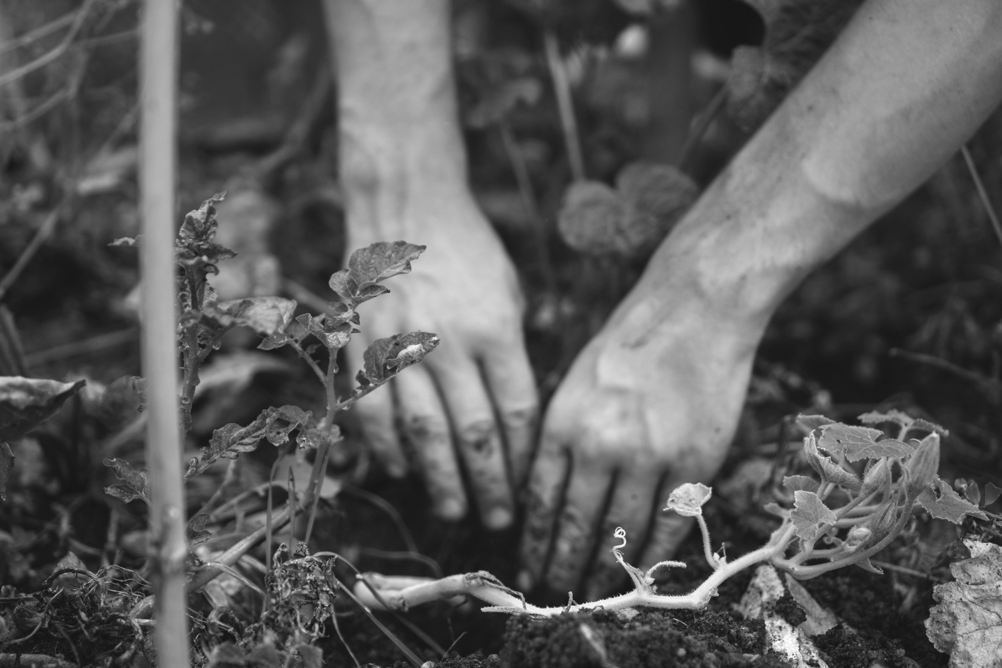
The practices of vegetable gardens, writes Mariateresa, allow us to bring order and identify, giving them primary value, what is essential for life: food, care, proper nourishment, unpoisoned, for the body; for humans, animals and the soil, highlighting the relationship of exchange between them. We too can keep this “tidying up” in mind when we are given the illusion that we can take sustenance for granted, which is often unhealthy and comes from faraway places or exploitation. If we think that today the trend is to have groceries and dinner delivered directly to our homes by ordering them online, it is clear that food production, from caring for the plant to cooking, becomes something detached, distant and taken for granted. Putting the vegetable garden at the centre is therefore also a recognition of our dependence on the materiality of existence and, in the case of MMC, of a broader participation in life together with the natural elements. This dependence can then be seen not as limiting, but as an authentic experience of being present in the world and of shared transformative learning, including with the plant and animal world. Furthermore, it allows us to rediscover creativity as part of nature’s way of giving itself: the discontinuity between seeds from different parts of the world, the importance of variety in the combination of plants and vegetables in the field, the native trees of each region, valuing differences.
Mariateresa’s book also made me reflect on how the large male-dominated capitalist market fits into the same circuit as the agroecology practised by women in the peasant movement, but with the opposite connotation. What I mean is not simply some contrasts between these approaches, which were already clear before reading the text (such as global production vs local production, for example). Rather, the discussion concerns the entire process and the links between one element and another in the circuit of which these contrasts are part.
It became clearer to me how the two models, peasant-female and capitalist-male, consciously participate in the circle of ecological relations, but one according to the care of the prosperity of life, the other bringing with it a perverse and sinister plot.
It is now clearer to me that the dominant model does not ignore relationships, which we know to be central to female thinking and practices, but rather that it now leverages them, the circularity between earth-nourishment-environment-health, while rigging the game and exploiting the harmful effects of this rigging. In fact, it is precisely from these chains that it derives the maximum benefit. The massive use of organic chemicals, weapons and the imposition of a single body of knowledge are also being pursued today with full knowledge of the interconnections between the primary elements in which women farmers’ politics want to participate in a virtuous way, also with a view to redistributing profits.
The peasant women’s movement (but also others) acts by caring for the vital elements (plants, water, soil…), aligning itself with the needs of the earth, the environment and humans without coercion, working for a healthy environment, supported by attention to diversity (of seeds, places and knowledge) and the cultivation of medicinal plants. The dominant system, on the other hand, has imposed itself on agriculture, starting from the military sphere. We know that the use of insecticides, herbicides and poisons began in the context of war. This deadly impulse has also made its way through the standardisation of knowledge and the variety inherent in the living world (monocultures, seed selection, transformation of seeds so that they cannot regenerate), to the point of compromising the health of the environment and its inhabitants. We also know that the multinationals responsible for distributing these products are often pharmaceutical companies. They therefore derive further income from the proliferation of new diseases.[7] The culmination of this process is the deterioration of many components of the ecosystem, accompanied by social conflict.
I then thought that it is not enough to be aware of the processes and relationships of the fabric in which we are immersed, but that what matters most is the meaning and value we give to these intertwined elements.
A further step that allowed me to engage in dialogue with Mariateresa was to bring the theme of “co-presence” (which she took from Aldo Capitini to talk about mysticism) into the ecological discourse. Above all, it provided me with a precise term to show, when I talk about ecology, the presences that I already felt were an important part of this theme, but which I did not know how to allude to. Thanks to her stories about the mysticism of peasant women in Brazil, I was able to make a transition from the sphere of politics among women to that of the bond with a territory. Let me give you an example: in defending my family’s land from the municipality’s invitation to subdivide it, I am not only opposed to the progressive cementification and urbanisation of green areas and the construction of new roads, even though they are not necessary, but I also take into account the invisible elements that make up this land. I am thinking of the small insects and animals that live in the soil, the birds that have nested there and will return in spring, but also the concrete knowledge of the people who have worked there, the nourishment that the fruits have given us, the friendship between us and the cherry trees, the cats and dogs that have run and played in this field, mapping its territory. The memories, the knowledge handed down, the intertwining stories of a place have generated a meaningful experience of shared learning in reciprocity, so that the field does not exist in itself, detached from these stories. These elements, which may be conscious or unconscious, are central to our relationship with the land and make themselves felt strongly when we have to defend it. This is how “co-presence”, i.e. the presence of multiple living, non-living, no longer living or not yet living entities, is something meaningful and relevant to the discourse on ecology.
Chiara Zamboni
I keep thinking about the practice of women farmers in southern Brazil, which Mariateresa presented to us in the interview and which has a special name, strange for a context as overtly political as theirs: mysticism.
It is a practice that seems to me to be worth considering from a feminist ecological perspective. First of all, it consists of living, lived connections between women and the Earth. At the mystical meetings, these women bring with them the best of what they have grown on their plots of land. They show it to each other and exchange knowledge, chess pieces and intentions. Vegetables, fruit and knowledge of what is essential for the soil are therefore an integral part of the mystical women’s political action. Cultivation serves to sustain the family, but it also represents the result of the intertwining of the fertility of the land and their personal work. The exchange of seeds, which regenerate themselves and which they know from experience, is not a generic political gesture against large multinationals, which impose seeds that do not regenerate. Their seeds are resistant to climate change, and they therefore consider them better from this point of view.
Moreover, it is a practice explicitly initiated by women in a political relationship with each other. We can consider it feminist – even if they do not usually use this term – because it concerns a choice of autonomy and freedom.
But why this seemingly out-of-place name, “mystical”, and how does it refer to the sacred? In reality, these women never offer an explanation. Rather, as in any ritual experience, one must participate first-hand to understand the special transcendent quality of the concrete and collective experience they implicitly suggest. The sacred dimension is only hinted at by the name they have chosen for this relational experience.
It seems to me that their mutual presence on Earth and to each other is reinforced by their practice of beginning each meeting by remembering the absent women who have been essential to them. Women of authority who, through their lives, have made that meeting possible at that moment. These are women they once knew, who were part of their movement, or women they never saw but who are important despite their absence, such as Rosa Luxemburg, who is sometimes mentioned by name. An entire genealogy of absent women, who were close or very distant, even in time. Naming them calls them to a presence there, even in their absence. And there is nothing stronger, I believe, than naming those who are not there but were there, to give presence to those who are there with the others and to make the movement of time felt.
Bibliography
Caterina Diotto, Mariateresa Muraca, Anna Maria Piussi, Chiara Zamboni, Intervista ad Antonietta Potente, “Per amore del mondo”, n. 18, 2022.
Aldo Capitini, La compresenza dei morti e dei viventi, Libreria Editrice Fiorentina, Firenze, 2022.
Philippe Descola, Oltre natura e cultura, Cortina editore, Milano, 2021.
Diotima, L’irrinunciabile. Alla radice dei bisogni, Mimesis, 2023.
Mariateresa Muraca, Come un seme nella terra. La mistica del Movimento di Donne Contadine del Brasile, “Per amore del mondo”, n. 15, 2017-2018.
Mariateresa Muraca, Educazione e movimenti sociali. Un’etnografia collaborativa con il Movimento di Donne Contadine a Santa Catarina (Brasile),Mimesis, Sesto San Giovanni (Mi), 2019.
Mariateresa Muraca, L’altra intercultura. Visioni e pratiche politico-pedagogiche da Abya Yala al mondo, PensaMultimedia, Lecce, 2022.
Originally published as:
C. Diotto, V. Ferri, M. Muraca, Annamaria Piussi, Giulia Testi, Chiara Zamboni,
Intervista a Mariateresa Muraca sul Movimento di Donne Contadine in Brasile, in “Per Amore del Mondo” No. 19/2022-2023 “Apriti cielo”, ISSN 2384-8944
Photographer: Jonathan Kemper (2020)
 Caterina Diotto