Paper to be presented at ICA2026 – 23rd International Congress of Aesthetics, “Aesthetics Today”, Prešov, Slovakia, 20-24 July 2026
Abstract
The fields of ecocriticism and intermediality have seen a growing interest for aesthetic phenomena that see literary elements intertwined with natural environments. The hiking trail represents a special form of human-nature relationship, and a phenomenon that has not yet been explored with such frames.
Traced along trade, migration and pilgrimage routes, trails have accompanied the evolution of the human-made landscape from antiquity to the present day. Artistic practices such as sculptures, paintings, carvings on stones or trees, music and performances have always contributed to the creation of intermedial narratives to guide travelers on their journey. A journey that is both exterior and interior, interweaving physical exertion with a path of self-reflection and spiritual transformation.
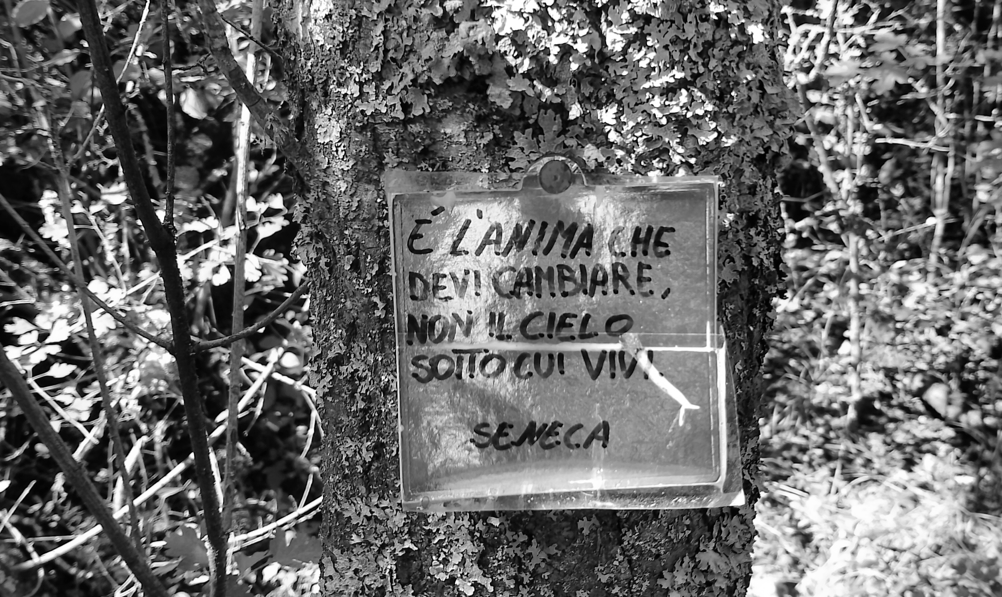
This paper will explore the literary practices that contribute to such narratives, also by analyzing three examples from the Italian hiking trail Via degli Dei, that connects Bologna to Florence.
Considering that literary references are more present in secular rather than pilgrimage trails, it will also suggest that literary imagery supersedes the role of religious imagery in the construction of narratives of self-criticism, liberation and courage.
Photographer: Caterina Diotto, Via degli Dei 2022
 Caterina Diotto