
What is a novel? What role and value does it have within our culture? During the 20th century, faced with the advance of the ideal of Progress made of machines and science, experiments and technologies, Heidegger lamented the loss of the Lebenswelt, the world of life, from the panorama of knowledge. Milan Kundera, on the contrary, was convinced that it was far from lost:
‘All the great existential themes […] have been revealed, shown, illuminated by four centuries of the novel. In its own way, according to its own logic, the novel has discovered, one after the other, the different aspects of existence’ (Kundera 1986)
If the novel has tapped into that field of being that the sciences no longer seem interested in or able to grasp, how should its discoveries be defined? The “question” raised by those who have criticised it as well as those who support its value always comes back to this knot: is what the novel shows us true or not true?
Should we consider the novel a source of knowledge to refer to or a mere source of entertainment, an illusion, an artificial representation of the world? On the other hand, is it possible to move it tout court into the realm of the false and fictional despite its popularity, its persistence and even expansion over the centuries? Despite the more than acknowledged influence it has exerted and still exerts on politics and history?
The novel is more alive than ever, and even more popular. Online writing in the form of blogs, collaborative writing apps, fan fiction and self-publishing are multiplying. Today, the novel seems to represent a mockery of the cultural – andpolitical – representation of the structure of knowledge, something that goes against the grain of established and emerging rules and hierarchies. It is often found where it should not be. It talks about things that ‘do not concern it’, often in ‘inappropriate’ ways. It is loved in spite of all logic and the unbridled imagination of its fictions. It always seems able to tell us something that involves us, something that, perhaps, has a lot to do with our existence in this world.
It is from this interweaving of questions and reflections that this book comes to life.
From Chiara Zamboni’s Afterword
In ‘Mythos, or the Relationship between Novel and Truth’, Caterina Diotto reasons about the epistemology of the modern, showing how increasingly vertiginous cracks are opening in it. The philosophical gamble of her text points the way to another epistemology, redistributing the cards of what is subject, of who performs the action, of what is truth beyond the true/false dichotomy.
Originally published as:
C. Diotto, Mythos, o del rapporto tra romanzo e verità. Per una teoria femminista del romanzo in dialogo con György Lukács e Walter Benjamin, OT/Orbis Tertius, Mimesis, Milan 2024. ISBN: 9791222302317
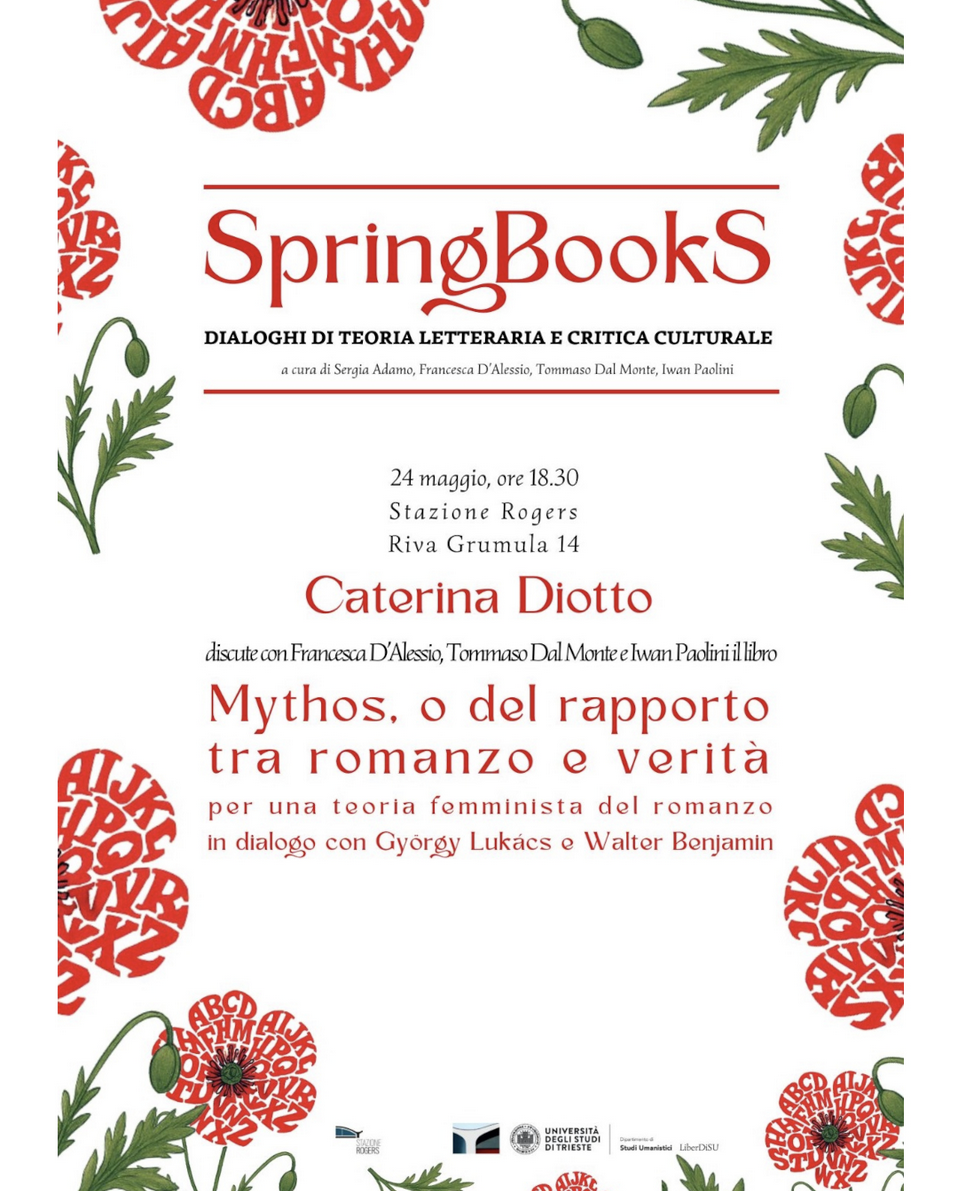
Book presentations
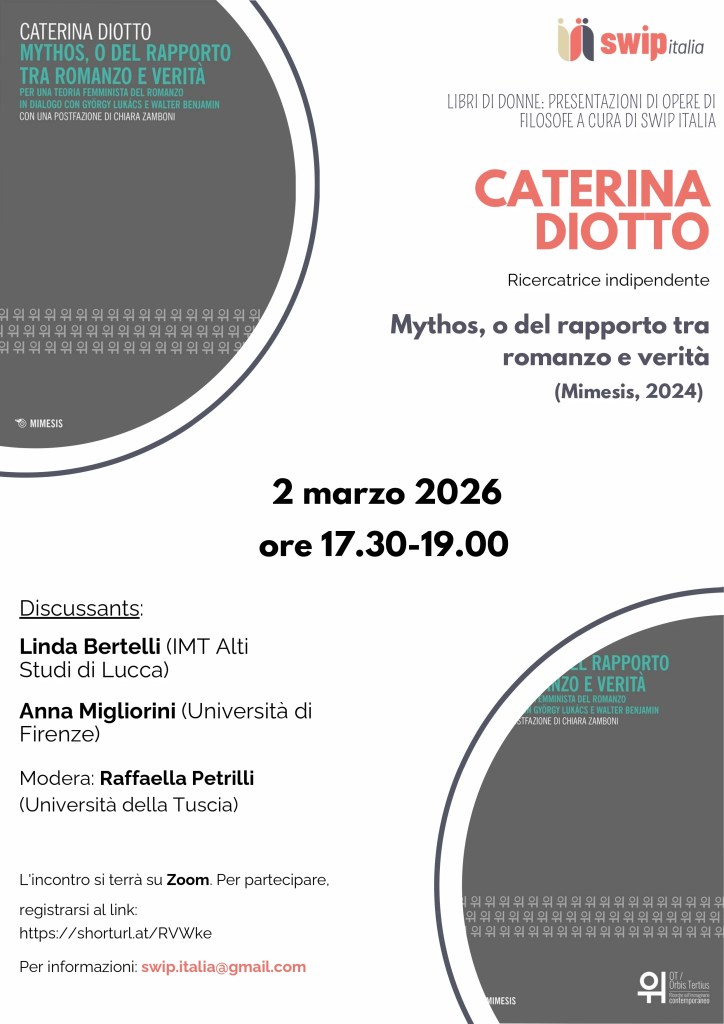
2nd March 2026 – SWIP Italia “Libri di Donne”
 Caterina Diotto